
Quick Answer
If your Illinois driver’s license was revoked because of a DUI or alcohol/drug-related offense, you will usually need to complete the Illinois Secretary of State hearing process before your driving privileges can be restored. That process often requires an alcohol/drug evaluation, DUI Risk Education, proof of completed treatment or early intervention, continuing care documentation, and other clinical records.
Hopewell Clinical helps clients prepare the clinical and treatment documentation commonly needed for Illinois license reinstatement, Restricted Driving Permit applications, BAIID-related requirements, and Secretary of State hearings.
Call 217-223-0170 to schedule an appointment or ask what documents you need before starting.

Help With the Illinois License Reinstatement Process
Losing your license after a DUI can affect employment, parenting, medical care, school, treatment participation, and basic daily responsibilities. The reinstatement process can also feel confusing because it involves more than simply waiting for time to pass.
In many Illinois DUI revocation cases, the Secretary of State will review whether you have addressed the alcohol or drug-related issues connected to the offense and whether restoring driving privileges would present a public safety concern. Clinical documentation is often a major part of that review.
Hopewell Clinical helps clients understand and complete the treatment-related side of the reinstatement process. This may include DUI evaluations, updated evaluations, treatment needs assessments, treatment completion documentation, continuing care status reports, and other records requested for Secretary of State hearings.
Hopewell Clinical is not a law firm and does not provide legal advice or guarantee hearing outcomes. Our role is to provide accurate, clinically appropriate documentation and treatment services that support the reinstatement or Restricted Driving Permit process.
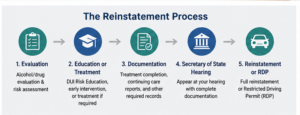
What Is Illinois Driver’s License Reinstatement?
License reinstatement means full restoration of your driving privileges after a suspension or revocation, provided all legal, administrative, financial, and clinical requirements have been satisfied.
For many DUI-related revocations, reinstatement requires a Secretary of State hearing. Depending on your record, you may need either an informal hearing or a formal hearing.
A successful reinstatement process may involve:
- Appearing before a Secretary of State hearing officer
- Completing an alcohol/drug evaluation
- Completing DUI Risk Education, early intervention, or substance use treatment if required
- Providing proof of treatment completion
- Providing a continuing care status report when required
- Submitting documentation of abstinence or non-problematic use when required
- Providing proof of financial responsibility, often through SR-22 insurance
- Paying required fees
- Completing any required BAIID obligations
- Passing any required driver’s license examinations
The exact requirements depend on your driving history, DUI risk classification, prior offenses, Secretary of State eligibility date, and hearing outcome.
Call 217-223-0170 to schedule a DUI evaluation, updated evaluation, continuing care report, or license reinstatement documentation appointment.
Restricted Driving Permit vs. Full Reinstatement
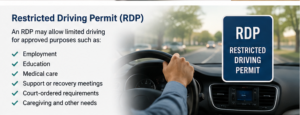
Many clients are not immediately eligible for full reinstatement. In those situations, a Restricted Driving Permit, often called an RDP, may be the first form of driving relief available.
A Restricted Driving Permit may allow limited driving for approved purposes such as:
- Employment
- Education
- Medical care
- Support or recovery meetings
- Court-ordered requirements
- Transportation for certain household or caregiving needs
Some permits require a Breath Alcohol Ignition Interlock Device, commonly called a BAIID. BAIID requirements are determined through the Secretary of State process and depend on the facts of your case and driving record.
Hopewell Clinical can help with the evaluation, treatment, and continuing care documentation often needed when applying for an RDP or full reinstatement.
Informal Hearings and Formal Hearings in Illinois
The type of hearing you need depends on your record.
An informal hearing is generally used for a single alcohol- or drug-related offense that did not involve a fatality or great bodily harm. Informal hearings are typically handled on a walk-in basis with a Secretary of State informal hearing officer.
A formal hearing is generally required for multiple DUI dispositions or for cases involving fatality or great bodily harm. Formal hearings must be requested in writing and are more structured. Many clients choose to work with an attorney for formal hearings.
Hopewell Clinical regularly helps clients prepare the clinical documentation used in both informal and formal hearing settings. We can also coordinate with your attorney when appropriate and with your written consent.
Clinical Documents Commonly Needed for License Reinstatement
The Secretary of State hearing process often requires documents that show your alcohol or drug-related risk has been evaluated and addressed. Depending on your case, you may need some or all of the following:
- Alcohol/Drug Evaluation Uniform Report
- Updated alcohol/drug evaluation
- DUI Risk Education completion documentation
- Early intervention completion documentation
- Substance use treatment completion documentation
- Continuing Care Status Report
- Treatment Needs Assessment
- Treatment waiver documentation when clinically appropriate
- Verification of abstinence or non-problematic use when required
- Support or recovery participation documentation when required
- Prior provider records
- Secretary of State denial letter, if you previously had a hearing and were denied
- Driving abstract and court-related DUI records
If you are unsure what you need, call 217-223-0170. Hopewell Clinical can review your situation from a clinical documentation standpoint and help identify the next appropriate step.
DUI Evaluation for License Reinstatement
A DUI evaluation is often one of the first clinical requirements in the license reinstatement process. The evaluation reviews your alcohol and drug use history, DUI circumstances, driving history, prior evaluations or treatment, risk factors, protective factors, and current functioning.
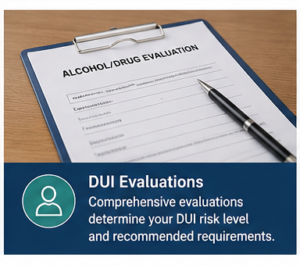
The evaluation results in a DUI risk classification. In Illinois, DUI risk classifications generally include:
- Minimal Risk
- Moderate Risk
- Significant Risk
- High Risk
Your risk classification affects the education, early intervention, treatment, continuing care, and documentation that may be required before a hearing.
Hopewell Clinical provides DUI evaluations for clients seeking license reinstatement, Restricted Driving Permits, Secretary of State hearing preparation, court compliance, probation compliance, and attorney-requested documentation.
Continuing Care Status Reports for Secretary of State Hearings
A Continuing Care Status Report is often required when a client has completed treatment and is preparing for a Secretary of State hearing. This report helps document current functioning, recovery stability, treatment gains, relapse prevention planning, support systems, abstinence or non-problematic use status when applicable, and prognosis.
A strong continuing care report should be accurate, specific, and clinically grounded. It should not simply say that treatment was completed. It should explain what changed, how the client is currently functioning, what recovery supports or protective factors are in place, and why the client’s prognosis is considered favorable when that conclusion is clinically supported.
Hopewell Clinical provides continuing care reports for eligible clients who have completed services and need updated documentation for license reinstatement or Restricted Driving Permit hearings.
What Hopewell Clinical Can Help With
Hopewell Clinical provides clinical services and documentation support for many parts of the Illinois DUI license reinstatement process, including:
- DUI evaluations
- Updated evaluations
- Alcohol/Drug Evaluation Uniform Reports
- DUI Risk Education support
- Early intervention
- Outpatient substance use treatment
- Relapse prevention
- Continuing care planning
- Continuing Care Status Reports
- Treatment completion documentation
- Treatment needs assessments
- Waiver documentation when clinically appropriate
- BAIID-related clinical documentation support
- Secretary of State hearing documentation review
- Coordination with attorneys, courts, probation, and prior providers when releases are signed
We help clients avoid unnecessary delays by identifying missing clinical records, reviewing prior documentation, and explaining what may still need to be completed from a treatment standpoint.
What Hopewell Clinical Does Not Do
Hopewell Clinical does not provide legal representation, legal strategy, or guarantees of reinstatement. Secretary of State hearing decisions are made by the Illinois Secretary of State, not by treatment providers.
You may choose to work with an attorney, especially if you have multiple DUI offenses, a prior denial, a formal hearing, a complex driving history, or questions about legal eligibility. Hopewell Clinical can provide clinical documentation to your attorney when you authorize us to do so.
When to Call Hopewell Clinical
You should contact Hopewell Clinical if:
- Your license was revoked after a DUI
- You need a DUI evaluation for Secretary of State purposes
- You are applying for a Restricted Driving Permit
- You have a Secretary of State hearing coming up
- Your attorney asked you to obtain updated clinical documentation
- You completed treatment but need a Continuing Care Status Report
- You were denied at a prior hearing and need help understanding the clinical documentation issues
- You need treatment documentation from a prior provider
- You are unsure whether your evaluation or treatment records are current
- You need help with BAIID-related documentation concerns
Calling early is important. Some documents must be current near the time of the hearing, and missing paperwork can delay the process.
Call 217-223-0170 to discuss scheduling and documentation needs.
What to Bring to Your Appointment
To help avoid delays, bring as many relevant documents as possible. These may include:
- Court Purposes Driving Abstract
- Law Enforcement Sworn Report or Notice of Summary Suspension
- DUI ticket, court paperwork, or sentencing order
- BAC, refusal, or toxicology information
- Prior DUI evaluations
- DUI Risk Education certificate
- Treatment completion records
- Continuing care records
- Secretary of State denial letter, if applicable
- Restricted Driving Permit paperwork, if applicable
- BAIID-related correspondence, if applicable
- Attorney instructions or hearing checklist
- Records from prior treatment providers
If you do not have all documents, call before your appointment. Hopewell Clinical can help you determine what is still needed.
Online and Telehealth Options for Illinois Clients
Hopewell Clinical offers telehealth options. Online services may be useful if you live outside Quincy, or Springfield have transportation issues, need documentation before a deadline, or are working with an attorney elsewhere in Illinois.
Telehealth may be available for:
- DUI evaluations when appropriate
- Updated evaluations
- Early intervention
- Outpatient substance use treatment
- Relapse prevention
- Continuing care
- Secretary of State-related documentation support
Call 217-223-0170 to ask whether online services may fit your case.
Illinois Areas We Serve
Hopewell Clinical provides license reinstatement-related clinical services for clients in Quincy, or Springfield and eligible telehealth clients across Illinois.
Common service areas include:
- Quincy
- Springfield
- Jacksonville
- Peoria
- Galesburg
- Decatur
- Bloomington-Normal
- Macomb
- West-Central Illinois
- Central Illinois
All scheduling is currently handled through the Quincy office.
Why Clients Choose Hopewell Clinical
Clients and referral partners choose Hopewell Clinical because we understand both the clinical treatment process and the documentation expectations commonly involved in Illinois DUI license reinstatement matters.
Hopewell Clinical offers:
- More than 20 years of experience helping clients with DUI-related clinical documentation
- DUI evaluations and Alcohol/Drug Evaluation Uniform Reports
- Outpatient substance use treatment
- Continuing care documentation
- Secretary of State hearing documentation support
- BAIID-related clinical documentation support
- In-person and appropriate telehealth options
- Clear explanations of treatment-related requirements
- Coordination with attorneys and referral sources when authorized
- Practical guidance for clients who feel overwhelmed by the process
Our goal is to help you understand what is required, complete clinically appropriate services, and move forward with organized documentation.
Start the License Reinstatement Process
If you need help with an Illinois DUI evaluation, treatment documentation, continuing care report, Restricted Driving Permit application, or Secretary of State hearing preparation, call Hopewell Clinical.
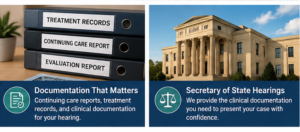
Call 217-223-0170 to schedule an appointment or ask what documents you should bring.
You can also use the contact form below and select License Reinstatement as the reason for your message.
Frequently Asked Questions
How do I get my license back after a DUI in Illinois?
To get your license back after an Illinois DUI revocation, you generally must go through the Secretary of State hearing process, complete an alcohol/drug evaluation, complete required DUI Risk Education or treatment, provide required documentation, pay fees, and satisfy any financial responsibility, BAIID, or testing requirements. The exact steps depend on your driving record and eligibility.
Do I need a DUI evaluation for Illinois license reinstatement?
In most DUI-related revocation cases, yes. An alcohol/drug evaluation is commonly required for Secretary of State hearings. The evaluation helps determine your DUI risk classification and what education, early intervention, treatment, or continuing care documentation may be needed.
What is a Restricted Driving Permit in Illinois?
A Restricted Driving Permit, or RDP, is limited driving relief that may allow approved driving for work, school, medical care, support meetings, court obligations, or other approved purposes. Some RDPs require installation of a BAIID device.
What is the difference between an informal hearing and a formal hearing?
An informal hearing is generally used for a single alcohol- or drug-related offense that did not involve fatality or great bodily harm. A formal hearing is generally required for multiple DUI dispositions or cases involving fatality or great bodily harm. Formal hearings are more structured and are often handled with attorney involvement.
Can Hopewell Clinical represent me at my Secretary of State hearing?
No. Hopewell Clinical is not a law firm and does not provide legal representation. We provide DUI evaluations, treatment, continuing care documentation, and clinical records that may be used in the hearing process. Clients may choose to work with an attorney for legal advice and hearing preparation.
What documents do I need for a Secretary of State hearing?
Common documents include an Alcohol/Drug Evaluation Uniform Report, proof of DUI Risk Education, treatment completion records, continuing care status report, driving abstract, court records, prior evaluations, denial letters, and any documentation requested by your attorney or hearing officer. Requirements vary by case.
How current does my DUI evaluation need to be?
For Secretary of State purposes, evaluations and updated evaluations often need to be current near the time of the hearing. If your evaluation is older or your circumstances have changed, you may need an updated evaluation. Call Hopewell Clinical at 217-223-0170 to review your clinical documentation needs.
Can I complete license reinstatement services online?
Some services may be available through telehealth when appropriate, including DUI evaluations, updated evaluations, treatment, early intervention, relapse prevention, and continuing care documentation. Telehealth availability depends on clinical and administrative requirements.
What if I completed treatment years ago?
You may still need updated documentation, a continuing care status report, or records from your prior provider. Hopewell Clinical can review available documentation and help determine whether additional clinical services or updated reports are needed.
What if my prior treatment provider closed or will not provide records?
Hopewell Clinical may be able to help review the available documentation and determine what can be clinically supported. If prior records are missing, additional assessment or updated documentation may be necessary. Call 217-223-0170 to discuss your situation.
Can Hopewell Clinical help with BAIID-related documentation?
Yes. Hopewell Clinical can help with the clinical documentation side of BAIID-related concerns when alcohol/drug evaluation, treatment, continuing care, or Secretary of State documentation is involved. BAIID program decisions and permit conditions are handled by the Secretary of State.
Does Hopewell Clinical guarantee that I will get my license back?
No. No treatment provider can guarantee a Secretary of State hearing outcome. Hopewell Clinical provides accurate clinical services and documentation to support the process, but the final decision is made by the Illinois Secretary of State.