
Written by Hopewell Clinical
Reviewed by Matt Dutton, BA, CADC
Quick Summary: Anger management counseling helps people recognize anger triggers, slow down impulsive reactions, communicate more effectively, and document completion when a court, probation officer, employer, attorney, or family situation requires proof of participation. The most important step is to clarify exactly what kind of program is being requested, how many sessions or hours are required, and whether the referral source will accept in-person, telehealth, or outpatient counseling documentation. Hopewell Clinical provides anger management support in Quincy, Springfield, Jacksonville, and across Illinois through telehealth. Call 217-223-0170 to ask about scheduling and documentation.

Why People Search for Anger Management
Most people do not look for anger management because life is going perfectly. They search because something happened: an argument went too far, a family member expressed concern, an employer warned them about their behavior, a probation officer recommended counseling, or a court case created a requirement they cannot ignore.
That does not mean someone is a “bad person.” Anger itself is a normal emotion. The problem is what happens when anger becomes too frequent, too intense, too hard to control, or too damaging to relationships, work, parenting, driving, legal compliance, or recovery.
Anger management counseling is designed to help a person understand the pattern behind angry reactions and build practical skills before those reactions create more consequences. SAMHSA describes anger management for substance use and mental health clients as a cognitive-behavioral model that can be used in clinical settings and focuses on structured skill-building across sessions.
For many clients, the goal is not to “never get angry.” That is unrealistic. The goal is to respond differently when anger shows up.
What Is Anger Management Counseling?
Anger management counseling is a structured educational and counseling process that helps clients identify triggers, recognize warning signs, challenge distorted thoughts, communicate more effectively, and choose safer responses during conflict.
A good anger management program usually addresses:
| Skill Area | What the Client Learns |
|---|---|
| Trigger awareness | Identifying people, situations, thoughts, or stressors that commonly lead to anger |
| Physical warning signs | Noticing clenched jaw, racing heart, raised voice, pacing, tension, or agitation |
| Cognitive restructuring | Challenging thoughts such as “They disrespected me,” “I have to win,” or “I can’t let this go” |
| Time-outs and de-escalation | Creating space before saying or doing something damaging |
| Communication skills | Using direct, respectful language instead of threats, insults, sarcasm, or intimidation |
| Accountability | Understanding the impact of behavior without blaming others for one’s reaction |
| Relapse prevention | Creating a plan for high-risk situations before they happen |
The American Psychological Association identifies several common anger-control strategies, including relaxation, cognitive restructuring, problem solving, better communication, humor used appropriately, and changing one’s environment when necessary.
In practice, anger management is often most useful when it moves beyond generic advice like “calm down” and helps the client understand the sequence: trigger → interpretation → body reaction → impulse → behavior → consequence.
Who May Benefit from Anger Management?
Anger management may be appropriate for adults who experience repeated problems with irritability, verbal aggression, conflict escalation, impulsive reactions, or difficulty calming down after being upset.
Common reasons people contact Hopewell Clinical for anger management include: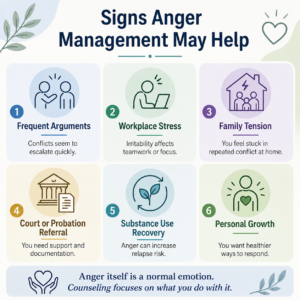
| Reason for Referral | Common Concern |
|---|---|
| Personal growth | “I do not like how angry I have become.” |
| Relationship conflict | “Arguments at home keep escalating.” |
| Parenting stress | “I lose patience and then feel guilty afterward.” |
| Workplace issue | “My employer told me I need counseling or documentation.” |
| Court or probation referral | “I was told to complete anger management.” |
| Attorney recommendation | “My lawyer suggested I start before court.” |
| Substance use recovery | “Alcohol or drug use makes my anger worse.” |
| DUI or legal stress | “Since my arrest, I have been more reactive and overwhelmed.” |
Anger management may also be useful when anger is connected to stress, shame, grief, financial pressure, family conflict, trauma history, substance use, or major life transitions. However, anger management is not a substitute for a full mental health evaluation when symptoms suggest depression, anxiety, trauma, bipolar disorder, or another clinical condition.
Anger Is Not Always the Primary Problem
One of the most important clinical questions is whether anger is the main issue or whether anger is a visible symptom of something else.
For example:
| What Looks Like Anger | What May Be Underneath |
|---|---|
| Irritability | Anxiety, depression, sleep deprivation, chronic stress |
| Explosive reactions | Trauma response, poor impulse control, substance use, shame |
| Verbal aggression | Learned conflict patterns, fear, insecurity, control issues |
| “I just snapped” | Build-up of resentment, avoidance, poor coping skills |
| Road rage | Stress, entitlement, impulsivity, substance use, poor emotional regulation |
| Family blowups | Unresolved conflict, parenting stress, financial pressure, alcohol use |
This is why anger management should not be treated as a box-checking exercise only. Documentation may matter, especially for court or probation, but real change usually requires honest attention to patterns, responsibility, and practical skill use between sessions.
Is Anger Management the Same as Therapy?
Not exactly.
Anger management often includes counseling skills, but it is usually more structured and skills-based than open-ended therapy. It may include education, worksheets, discussion, role-play, homework, behavior tracking, and completion documentation.
Traditional therapy may go deeper into trauma, attachment, depression, anxiety, family history, or long-term relational patterns. Some clients need both: anger management for immediate skill-building and counseling for the deeper issues that keep the anger cycle going.
For clients with substance use concerns, anger management may also overlap with relapse prevention. Anger is a common high-risk emotional state for alcohol or drug use, and substance use can lower inhibition, worsen conflict, and make it harder to pause before reacting.
Court-Ordered or Probation-Recommended Anger Management in Illinois
Some clients seek anger management because a judge, probation officer, attorney, employer, or court services department recommends or requires it. In those situations, the clinical work matters, but documentation becomes especially important.
Illinois court and probation situations vary by county, charge, referral source, and individual order. Problem-solving courts in Illinois may involve coordinated treatment and supervision for individuals with mental health or substance use concerns, and Illinois courts describe these programs as alternative forums for certain individuals in the criminal justice system.
For court or probation referrals, clients should clarify:
- Who is requiring the program?
Court, probation, attorney, employer, DCFS, school, family court, or another referral source? - How many hours or sessions are required?
Some referrals specify a number of sessions. Others simply say “anger management evaluation and follow recommendations.” - Is telehealth allowed?
Some referral sources accept telehealth documentation, while others may prefer or require in-person attendance. - Does the provider need to send reports directly?
Some clients only need a completion letter. Others need progress reports, attendance updates, or communication with probation or an attorney. - Is this actually anger management, or is a different program required?
This distinction matters, especially when domestic violence, intimate partner violence, substance use treatment, or mental health treatment is involved.
Hopewell Clinical can help clients understand what information is needed for scheduling and documentation, but clients should rely on their attorney, probation officer, or court order for legal requirements.
Anger Management vs. Partner Abuse Intervention Program in Illinois
This is a critical distinction.
General anger management is not always appropriate when the referral involves intimate partner violence, domestic battery, coercive control, or a pattern of power and control in a relationship. Illinois Administrative Code Title 89, Part 501 defines “anger management” as a cognitive restructuring program appropriate for stranger or non-intimate violence only, distinguishing it from intimate partner violence dynamics involving power and control.
The Illinois Department of Human Services describes Partner Abuse Intervention Programs, or PAIP, as services for individuals who may be court ordered or may volunteer to attend, with a purpose of reducing and preventing domestic violence. IDHS notes that PAIP addresses abusive behavior, responsibility, attitudes and beliefs, and tools for becoming non-abusive partners and parents.
That means a client should not assume a general anger management class will satisfy a domestic violence-related requirement.
Practical Rule
If the incident involved a spouse, dating partner, former partner, household member, coercive control, intimidation, stalking, threats, physical aggression, or domestic battery, the client should ask the court, probation officer, attorney, or referral source whether a PAIP-approved program is required instead of general anger management.
Hopewell Clinical can provide anger management services, but anger management should not be represented as a substitute for PAIP when PAIP is specifically required.
Anger Management vs. Substance Use Treatment
Anger and substance use often interact, but they are not the same issue.
Some clients are able to manage anger well when sober but become reactive, aggressive, or impulsive when drinking or using drugs. Others use alcohol or drugs after conflict because they do not know how to calm down. Some experience both.
| Concern | Anger Management Focus | Substance Use Treatment Focus |
|---|---|---|
| Explosive arguments | De-escalation, communication, trigger awareness | Whether alcohol/drug use contributed to conflict |
| Legal incident | Behavior accountability and documentation | Assessment, diagnosis, level of care, relapse prevention |
| Family conflict | Conflict patterns and safer responses | Impact of use on family functioning |
| Probation referral | Compliance with anger-related recommendations | Compliance with SUD evaluation/treatment recommendations |
| Recovery risk | Managing anger without escalation | Avoiding use during high-risk emotional states |
Illinois law allows courts, under certain circumstances, to require assessment and treatment related to substance use disorder as a condition of probation when clinically indicated. Although that statute is not an anger management law, it illustrates an important point: courts may separate behavioral, substance use, and mental health requirements depending on the case.
For clients with DUI, alcohol-related charges, drug-related charges, or recovery concerns, anger management may be one part of a broader treatment or compliance plan.
What Happens During Anger Management Counseling?
The first session usually focuses on understanding the referral reason, the client’s goals, the anger pattern, and any documentation needs. A clinician may ask about recent incidents, legal requirements, family concerns, work stress, substance use, mental health history, and prior counseling. 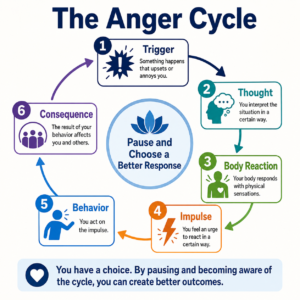
Typical anger management sessions may include:
1. Identifying Anger Triggers
Clients learn to name the situations that set off anger. Triggers may include disrespect, criticism, feeling ignored, financial pressure, parenting stress, traffic, intoxication, embarrassment, or feeling controlled.
The goal is not to blame the trigger. The goal is to recognize the pattern early enough to choose a different response.
2. Recognizing Early Warning Signs
Many people notice anger only after they are already yelling, threatening, shutting down, or acting impulsively. Counseling helps clients recognize earlier physical and emotional cues, such as:
- Tight chest
- Racing heart
- Heat in the face
- Clenched fists
- Jaw tension
- Pacing
- Sarcasm
- Interrupting
- Repeating the same point
- Feeling an urgent need to “win”
Once a person can identify early warning signs, they have a better chance of interrupting the behavior before it escalates.
3. Challenging Anger-Producing Thoughts
Anger often grows from interpretations, not just events.
For example:
| Automatic Thought | More Balanced Reframe |
|---|---|
| “They are disrespecting me.” | “I feel disrespected, but I need to ask what they meant.” |
| “I have to make them understand.” | “I can explain once and step away if this is escalating.” |
| “They always do this.” | “This is a pattern, but exaggerating it will not help me respond well.” |
| “If I walk away, I lose.” | “Taking a time-out may prevent me from making this worse.” |
| “I can’t control it.” | “I may not control the feeling immediately, but I can control what I do next.” |
This is one reason cognitive-behavioral approaches are commonly used in anger management. SAMHSA’s anger management model for substance use and mental health clients is explicitly cognitive-behavioral and structured around skill practice.
4. Learning Time-Outs That Actually Work
A time-out is not storming out, slamming a door, leaving someone anxious, or using silence as punishment. A healthy time-out is a planned de-escalation strategy.
A better time-out statement might sound like:
“I am getting too angry to talk about this well. I am going to take 30 minutes to cool down, and then I will come back so we can finish the conversation.”
The key is to return to the issue later. Avoidance is not anger management; it is delayed conflict.
5. Practicing Communication Skills
Many anger problems are communication problems under pressure. Clients may learn to:
- Use “I” statements without blame
- Make specific requests
- Listen without interrupting
- Avoid name-calling or threats
- Lower voice volume
- Stay with one issue at a time
- Repair after conflict
- Apologize without excuses
- Set boundaries without intimidation
6. Building a Personal Anger Control Plan
A useful anger plan identifies:
- Top triggers
- Early warning signs
- High-risk situations
- People to call
- Time-out plan
- Coping skills
- Substance use risks
- Repair steps after conflict
- Documentation or compliance requirements
The plan should be specific enough to use outside the counseling office.
What Documents Should You Bring?
If anger management is connected to court, probation, an attorney, employment, or another referral source, bring as much relevant information as possible.
| Document or Information | Why It Helps |
|---|---|
| Court order or referral paperwork | Confirms what is required |
| Probation officer name and contact information | Helps with documentation if releases are signed |
| Attorney contact information | Helps coordinate if attorney-requested documentation is needed |
| Case number, if available | Helps identify the matter on letters or reports |
| Required number of sessions or hours | Prevents completing the wrong amount |
| Deadline | Helps avoid late compliance |
| Employer or HR request, if applicable | Clarifies documentation expectations |
| Prior counseling or treatment records, if relevant | Helps avoid repeating work unnecessarily |
| Photo ID and contact information | Needed for intake and records |
If the referral source gave verbal instructions, write them down before the appointment. Many delays happen because the client says, “I think they told me anger management,” but no one knows whether that means an evaluation, a specific number of classes, a progress letter, or a different type of program altogether.
Common Mistakes That Delay Completion
Anger management is usually straightforward when the requirement is clear. Delays often happen because of preventable misunderstandings.
Mistake 1: Starting the Wrong Program
Not every “anger class” meets every court, probation, employer, or attorney requirement. Some referral sources may accept outpatient counseling documentation. Others may require a specific provider, curriculum, number of hours, or in-person format.
Mistake 2: Confusing Anger Management with PAIP
If the case involves intimate partner violence or domestic violence, general anger management may not satisfy the requirement. Illinois distinguishes anger management for non-intimate violence from PAIP-related partner abuse intervention.
Mistake 3: Waiting Until the Deadline Is Close
Clients often wait until a court date, probation review, or employment deadline is only a few days away. That creates unnecessary stress and may limit scheduling options.
Mistake 4: Attending but Not Participating
Completion letters may document attendance, but meaningful progress usually requires participation. If a client sits through sessions while blaming everyone else, the underlying risk pattern may remain unchanged.
Mistake 5: Not Signing Releases
If a provider needs to communicate with probation, an attorney, court services, or an employer, the client usually needs to sign a proper release of information. Without that, the provider may not be able to confirm attendance or send documentation.
Mistake 6: Assuming Telehealth Is Automatically Accepted
Telehealth can be appropriate and helpful for many Illinois clients, especially those with transportation barriers or work schedules. However, clients should confirm that the referral source accepts telehealth documentation before assuming it will satisfy the requirement.
Can Anger Management Be Completed Online or by Telehealth in Illinois?
In many situations, anger management counseling may be available through telehealth, depending on clinical appropriateness, documentation needs, and referral-source approval. Telehealth can be especially useful for clients in rural areas, clients without reliable transportation, or clients trying to balance work, family, and court requirements.
However, telehealth is not always the right fit. In-person services may be preferred or required when:
- The court or probation officer specifies in-person attendance
- The client needs a higher level of care
- Safety concerns are present
- The referral involves domestic violence or PAIP-specific requirements
- The client cannot participate privately and safely from home
- The client needs more intensive mental health or substance use treatment
Before starting, ask the referral source: “Will you accept anger management counseling completed by telehealth with documentation from Hopewell Clinical?”
How Long Does Anger Management Take?
The answer depends on the referral source and the client’s needs.
Some people may be asked to complete a short educational program. Others may be referred for multiple counseling sessions. SAMHSA’s published anger management manual uses a 12-week cognitive-behavioral group model for substance use disorder and mental health clients, but that does not mean every client needs exactly 12 sessions.
The required length may depend on:
- Court or probation requirements
- Employer expectations
- Severity of the incident
- Pattern of repeated behavior
- Substance use involvement
- Domestic violence concerns
- Mental health symptoms
- Client progress and participation
- Need for documentation
A client should not assume that a one-time class will satisfy a referral unless the referral source confirms it.
What Does Anger Management Documentation Usually Include?
Documentation depends on what is requested and what releases are signed. A basic completion letter may include:
- Client name
- Program or service completed
- Dates of attendance
- Number of sessions or hours
- General participation statement, when appropriate
- Provider name and contact information
- Signature or agency verification
A progress letter may include:
- Attendance to date
- Engagement level
- Topics addressed
- Remaining sessions
- Compliance with scheduling
- General clinical progress, within confidentiality limits
A more detailed report may be appropriate only when requested, clinically justified, and authorized by the client through proper releases.
Hopewell Clinical can help clients understand what documentation can be provided, but the provider cannot guarantee that a court, probation officer, employer, or other referral source will accept a particular document.
Anger Management for DUI, Substance Use, and Legal Stress
DUI cases often create stress, shame, financial pressure, family conflict, transportation problems, and fear about employment or license consequences. Even when anger was not part of the arrest, many clients notice that they become more irritable afterward.
For DUI clients, anger management may be relevant when:
- Arguments increased after the arrest
- Alcohol use contributed to conflict
- The client feels resentful, embarrassed, or defensive
- Family members are pressuring the client to change
- The client is struggling with court or probation stress
- Emotional reactions increase relapse risk
- The attorney or probation officer recommends additional counseling
Anger management does not replace a DUI evaluation, DUI Risk Education, early intervention, treatment, continuing care, or Secretary of State hearing documentation when those are required. It may, however, support better emotional regulation and compliance during the broader legal or recovery process.
If you need anger management counseling for court, probation, an attorney, work, family concerns, DUI-related stress, or personal growth, call Hopewell Clinical at 217-223-0170. Ask what documents to bring, whether telehealth may be appropriate, and what type of completion documentation may be available.
Local Anger Management Support in Quincy and Across Illinois
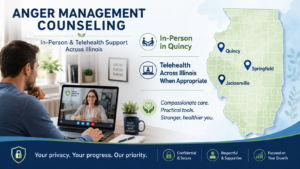
Hopewell Clinical is based in Quincy, Illinois, and serves clients in Adams County and surrounding West-Central Illinois communities. Depending on clinical appropriateness and referral requirements, Hopewell may also support clients from areas such as Springfield, Sangamon County, Jacksonville, Morgan County, Macomb, Galesburg, Peoria, Decatur, Bloomington-Normal, Danville, Carbondale, La Salle, and other Illinois communities through telehealth options.
Local clients often contact Hopewell Clinical because they need help balancing several pressures at once: court dates, work schedules, probation appointments, transportation barriers, family expectations, and documentation deadlines. A local outpatient provider can help clients approach anger management as both a compliance step and a practical opportunity to prevent future problems.
For clients in rural or smaller communities, telehealth may reduce travel time and make it easier to start sooner. Still, clients should verify telehealth acceptance with the referral source before beginning if the program is court-, probation-, or employer-related.
How to Prepare Before the First Appointment
Before starting anger management counseling, take a few minutes to prepare. This can make the first session more useful and reduce delays.
Bring or Know the Following
- Why you are seeking anger management
- Whether it is voluntary or required
- Who referred you
- Any deadline
- Number of required hours or sessions
- Whether a completion letter is needed
- Whether reports must go to probation, court, attorney, or employer
- Whether substance use was involved in the incident
- Whether the incident involved an intimate partner or household member
- Any prior treatment or counseling history
- Current medications or mental health concerns, if relevant
Questions to Ask the Referral Source
If anger management is required, ask:
- “How many sessions or hours do I need?”
- “Do you require a specific provider or curriculum?”
- “Will you accept telehealth?”
- “Do you need a completion letter, progress report, or both?”
- “Where should documentation be sent?”
- “Is this general anger management, or do I need a Partner Abuse Intervention Program?”
The last question is especially important in cases involving domestic violence or intimate partner conflict.
Practical Anger Management Skills You Can Start Using Now
Counseling provides structure and accountability, but clients can begin practicing basic skills immediately. 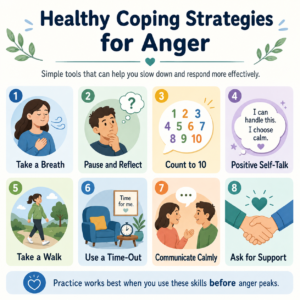
Use a 10-Second Pause
When you feel the urge to interrupt, insult, threaten, or escalate, pause for 10 seconds. That brief delay may be enough to prevent the first damaging sentence.
Lower Your Voice Before You Choose Your Words
Many conflicts escalate because tone changes before content does. Lowering your voice can help your body slow down and may reduce the other person’s defensiveness.
Name the Feeling Under the Anger
Anger is often easier to express than fear, shame, hurt, embarrassment, disappointment, or anxiety. Try saying privately, “What else am I feeling besides anger?”
Take a Real Time-Out
A real time-out includes a return plan. “I need 30 minutes, and then I will come back to talk” is different from leaving, disappearing, or refusing to speak.
Avoid Alcohol or Drugs During High-Conflict Times
Substances can lower inhibition and make anger harder to control. If conflict is likely, sobriety and distance are often safer choices.
Repair Quickly
A repair does not erase the behavior, but it can reduce further damage. A useful repair sounds like: “I raised my voice and insulted you. That was not okay. I am going to take a break and come back when I can speak respectfully.”
When Anger Requires More Than Anger Management
Anger management may not be enough when there are safety risks, serious mental health symptoms, active addiction, threats, stalking, physical violence, weapons involvement, suicidal thoughts, or fear in the home.
Seek immediate help or crisis support if anger is connected to:
- Threats of harm to self or others
- Physical violence
- Use of weapons
- Fear for safety
- Stalking or coercive control
- Severe depression or suicidal thoughts
- Psychosis, mania, or severe instability
- Uncontrolled substance use
- Child safety concerns
The Illinois Department of Human Services lists the Illinois Domestic Violence Helpline as 1-877-863-6338, available 24/7, toll-free, multilingual, and confidential. For immediate danger, call emergency services.
Anger management counseling can help you move from reacting to responding. Whether you are seeking help voluntarily or need documentation for court, probation, an attorney, work, or family concerns, Hopewell Clinical can help you understand the next step.
Call Hopewell Clinical at 217-223-0170 to ask about anger management counseling in Quincy, Illinois, and telehealth options across Illinois when appropriate. If your referral is court- or probation-related, have your paperwork, deadline, and documentation requirements available when you call.
Frequently Asked Questions
Does Illinois require anger management for certain court cases?
Illinois requirements vary by case, county, court order, probation conditions, and referral source. Some people may be ordered or advised to complete anger management, counseling, substance use treatment, mental health services, or a different program. Ask your attorney, probation officer, or court services contact exactly what is required before starting.
Is anger management the same as domestic violence counseling?
No. In Illinois, general anger management is not the same as a Partner Abuse Intervention Program. Illinois Administrative Code distinguishes anger management for stranger or non-intimate violence from intimate partner violence issues involving power and control. If your case involves domestic violence or intimate partner conflict, ask whether PAIP is required.
Can I complete anger management online in Illinois?
Telehealth or online anger management may be appropriate in some situations, but acceptance depends on the referral source. Courts, probation officers, employers, attorneys, or agencies may have specific requirements. Always confirm whether telehealth will be accepted before beginning a program for documentation purposes.
What should I bring to my first anger management appointment?
Bring your photo ID, referral paperwork, court or probation documents, attorney contact information, deadline, and any instructions about required hours or sessions. If the referral source needs documentation, ask where it should be sent and whether you need to sign a release of information.