
Written by Hopewell Clinical
Clinically reviewed by Matt Dutton, BA, CADC
Quick Summary
An Illinois DUI evaluation is used to determine a DUI risk classification and recommend the minimum education, early intervention, treatment, or continuing care that may be required for court or Secretary of State purposes. After the evaluation, your next steps usually depend on your assigned risk level, your court date, whether you need Secretary of State documentation, and whether any additional records are missing. Hopewell Clinical provides DUI evaluations, DUI Risk Education support, treatment documentation, and related services in Quincy, Springfield, Jacksonville, and appropriate Illinois telehealth settings. Call 217-223-0170 to ask about scheduling and required documents.
An Illinois DUI evaluation does not end when the interview is complete. The evaluation leads to an assigned risk classification, a written recommendation, and documentation that may be used by the court, probation, an attorney, or the Illinois Secretary of State. Depending on the case, the next step may be DUI Risk Education, early intervention, outpatient treatment, continuing care documentation, Secretary of State hearing paperwork, or additional records review.
This article explains what usually happens after an Illinois DUI evaluation, what each risk level generally means, why documentation sometimes gets delayed, and when to call Hopewell Clinical for help.

What Is the Purpose of an Illinois DUI Evaluation?
An Illinois DUI evaluation is an alcohol and drug assessment completed after a DUI arrest or related impaired-driving matter. Under Illinois Administrative Code Title 77 Part 2060, DUI evaluation services are used to determine the person’s risk to public safety and make a corresponding recommendation to the Illinois courts or the Office of the Secretary of State.
The evaluation is not simply a casual conversation. It is a structured clinical and regulatory process. The evaluator generally reviews alcohol and drug use history, driving history, DUI-related records, chemical test or refusal information, prior evaluations or treatment, criminal-history information when relevant, and other factors that may affect risk classification.
The evaluation also helps determine whether the person needs only DUI Risk Education or whether additional early intervention, treatment, or continuing care may be recommended.
A DUI evaluation is commonly needed for:
- A pending Illinois DUI court case
- Probation or court compliance
- Attorney review before court
- Secretary of State hearings
- Restricted Driving Permit requests
- Illinois license reinstatement
- BAIID-related documentation issues
- Updated documentation after prior treatment or evaluation
- Out-of-area or telehealth-related DUI service planning
Hopewell Clinical helps clients understand the clinical evaluation process, gather relevant records, complete appropriate services, and prepare documentation. Hopewell Clinical does not provide legal advice and does not replace the role of an attorney.
What Happens Immediately After the DUI Evaluation?
After the interview and records review, the evaluator completes the clinical and regulatory analysis needed to assign a DUI risk classification. That classification is then documented, along with the corresponding recommended intervention.
In Illinois, the summary of the DUI evaluation, the assigned risk level, and the corresponding intervention are documented on the DHS/DBHR Alcohol and Drug Evaluation Uniform Report. Part 2060 states that the Uniform Report is produced through the electronic DUI Services Reporting System, often referred to as eDSRS.
In practical terms, after your DUI evaluation, several things may happen:
- Your evaluator may need to review missing records.
- Your risk classification is determined based on all available information.
- Your recommended services are identified.
- Your Uniform Report is completed.
- You may be referred for DUI Risk Education, early intervention, treatment, or continuing care.
- Your documentation may be sent to the appropriate court or prepared for Secretary of State use, depending on the case.
The process can move quickly when all records are available. It can slow down when documents are missing, when prior DUI-related history is unclear, or when the client has previously completed an evaluation, treatment, or court-ordered service somewhere else.
The Main Documents Used After a DUI Evaluation
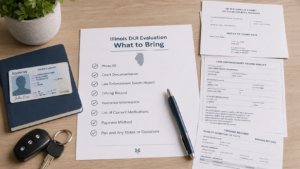
The exact documents needed vary by case, but many Illinois DUI evaluation files involve some combination of the following:
| Document | Why It Matters |
| Photo ID | Confirms identity for the evaluation and related services. |
| Law Enforcement Sworn Report | Helps document the arrest, BAC, refusal, and summary suspension details. |
| Ticket or court paperwork | Helps identify the charge, court location, case number, and court date. |
| Driving abstract or court-purpose driving record | Helps confirm prior DUI-related driving history and suspensions. |
| Chemical test or refusal information | May affect DUI risk classification and recommendations. |
| Prior DUI evaluations | Required when previous evaluations exist for the same or related DUI matter. |
| Treatment completion records | Helps determine whether prior recommendations were completed. |
| Secretary of State paperwork | Needed when the evaluation relates to a hearing, reinstatement, or permit request. |
| Attorney or probation instructions | Helps clarify deadlines and where paperwork must be submitted. |
Illinois Part 2060 requires the DUI evaluation record to include documentation of the driving record and chemical test or refusal results, along with the Uniform Report and supporting narrative information.
A common mistake is assuming that the evaluator can finalize everything based only on the client’s memory. The client’s self-report matters, but DUI evaluation documentation often depends on official records.
Illinois DUI Risk Classifications: What They Generally Mean

Illinois DUI evaluations assign one of four risk classifications:
- Minimal Risk
- Moderate Risk
- Significant Risk
- High Risk
The classification is based on the total information obtained during the evaluation. Illinois DHS/SUPR guidance explains that the risk assignment is considered an initial finding and may be subject to change if additional information is obtained during a later evaluation.
It is important not to guess your risk level before the evaluation is complete. BAC information, refusal information, prior DUI-related history, court-ordered supervisions, statutory summary suspensions, reckless driving reductions, substance use symptoms, and other records may all matter.
Minimal Risk
Minimal Risk generally applies when the evaluation identifies no prior DUI, BUI, or SUI convictions or court-ordered supervisions; no prior statutory summary suspensions; no prior reckless driving conviction or supervision reduced from DUI, BUI, or SUI; a BAC below .15 for the current arrest; no identified pattern of alcohol- or drug-impaired driving; and no substance use disorder symptoms. DHS/SUPR’s revised classification guidance identifies these factors for Minimal Risk.
The typical minimum recommendation for Minimal Risk is completion of DUI Risk Education.
Moderate Risk
Moderate Risk generally applies when there is no prior DUI-related conviction, supervision, statutory summary suspension, or qualifying reckless-driving reduction, but the current case involves a BAC of .15 to .19, an implied-consent refusal, or at most one symptom of a substance use disorder.
The typical minimum recommendation for Moderate Risk includes DUI Risk Education and early intervention.
Significant Risk
Significant Risk may apply when there is one prior DUI-related conviction, court supervision, statutory summary suspension, or qualifying reckless-driving reduction before the current offense; a BAC of .20 or higher in the current case; or two or three symptoms of a substance use disorder.
The typical minimum recommendation for Significant Risk includes DUI Risk Education and outpatient substance use treatment.
High Risk
High Risk may apply when there are two or more prior qualifying alcohol- or drug-related driving incidents before the current offense or four or more symptoms of a substance use disorder. DHS/SUPR’s revised guidance identifies these criteria as part of the High Risk classification.
The typical minimum recommendation for High Risk is a higher amount of outpatient substance use treatment and ongoing continuing care participation after discharge.
Risk Level and Minimum Recommended Services
The following table summarizes the general relationship between Illinois DUI risk classification and recommended intervention under Part 2060. The recommendation should be understood as a minimum starting point, not a guarantee that no additional services will ever be needed. Illinois Part 2060 states that after a risk determination, the corresponding intervention is recommended as the minimum necessary and not necessarily the final intervention if later information becomes relevant.
| Illinois DUI Risk Classification | Typical Minimum Recommendation |
| Minimal Risk | Minimum 10 hours DUI Risk Education |
| Moderate Risk | Minimum 10 hours DUI Risk Education plus minimum 12 hours early intervention over at least four weeks |
| Significant Risk | Minimum 10 hours DUI Risk Education plus minimum 20 hours substance use treatment and continuing care participation after discharge |
| High Risk | Minimum 75 hours substance use treatment and continuing care participation after discharge |
These categories can be confusing because they sound simple, but the underlying analysis can be technical. A first DUI arrest does not automatically mean Minimal Risk. A person’s BAC, refusal, prior summary suspensions, prior reckless-driving reductions, substance use symptoms, and other records can affect the outcome.
DUI Risk Education: What It Is and When It Is Required
DUI Risk Education is a structured educational service related to impaired driving and substance use risk. Illinois Part 2060 states that DUI Risk Education may be provided in person or online and is intended to provide orientation regarding the impact of substance use on driving skill and the personal ramifications of substance use.
Under Part 2060, DUI Risk Education includes at least 10 hours of instruction, divided into at least four sessions on different days, with no session exceeding three hours. When DUI Risk Education is provided online, identity verification and active-participation checks are required.
DUI Risk Education is not the same as treatment. It is an educational intervention. Some clients need only DUI Risk Education. Others need DUI Risk Education plus early intervention or treatment.
DUI Risk Education May Cover Topics Such As:
- How alcohol and other drugs affect driving
- Residual impairment and decision-making
- Illinois impaired-driving laws and consequences
- Substance use patterns and risk factors
- Impact on family, employment, and legal functioning
- Treatment and recovery support options
- Secretary of State hearing and driving-relief issues
Hopewell Clinical can help clients understand whether DUI Risk Education is part of their recommendation and how to complete services in a way that aligns with court or Secretary of State needs.
Early Intervention, Treatment, and Continuing Care
After an Illinois DUI evaluation, some clients are recommended to complete more than DUI Risk Education.

Early Intervention
Early intervention is generally associated with Moderate Risk cases. It is not the same as outpatient treatment. It is designed for clients whose evaluation suggests elevated risk but does not necessarily indicate the same level of treatment need as a substance use disorder treatment recommendation.
In many cases, early intervention helps the client examine risk factors, consequences, decision-making patterns, and prevention strategies before problems become more serious.
Outpatient Substance Use Treatment
Significant Risk and High Risk classifications typically involve outpatient substance use treatment. The number of recommended hours depends on the risk classification and the clinical picture.
Treatment may focus on:
- Substance use patterns
- Relapse-prevention planning
- Impaired-driving risk
- Emotional and behavioral triggers
- Accountability and decision-making
- Family, work, legal, and social consequences
- Recovery supports
- Continuing care planning
Treatment is not simply a punishment or box-checking exercise. When done well, it helps clients understand what contributed to the DUI event, what needs to change, and how to reduce future risk.
Continuing Care
Continuing care is often required after treatment for Significant Risk and High Risk clients. Continuing care may involve ongoing recovery-support activities, follow-up counseling, support group participation, relapse-prevention work, or other activities identified in the continuing care plan.
For Secretary of State matters, continuing care documentation can be especially important because the hearing process often examines not only whether treatment was completed, but whether the client’s current functioning and recovery plan are stable and well documented.
Court Requirements vs. Secretary of State Requirements
One of the most common sources of confusion after an Illinois DUI evaluation is the difference between court requirements and Secretary of State requirements.
A DUI court case and a driver’s license reinstatement or permit matter are related, but they are not the same process.
Court-Related DUI Evaluation
For court, the DUI evaluation may be used by the judge, prosecutor, defense attorney, probation department, or court services department. The court may monitor whether the client completes the recommended education, early intervention, or treatment.
Illinois law states that the court shall monitor compliance with remedial education or treatment recommendations contained in the professional evaluation, and programs conducting alcohol or other drug evaluation or remedial education must be licensed by the Department of Human Services.
Secretary of State Documentation
For Secretary of State purposes, the evaluation and related documentation may be used in connection with:
- Formal or informal hearings
- Restricted Driving Permit requests
- Full license reinstatement
- BAIID-related matters
- Updated evaluations
- Continuing care status reports
- Treatment need assessments and waivers
- Documentation after a denial
The Secretary of State’s office maintains DUI publications and forms, including the DUI Fact Book and Road to Reinstatement materials.
A client may complete what the court required but still need additional documentation for the Secretary of State. This can be frustrating, but it is common. The Secretary of State process often requires a more complete picture of the client’s alcohol or drug history, treatment history, abstinence or current-use pattern, support system, relapse-prevention approach, and current risk.
What If You Need a Restricted Driving Permit or License Reinstatement?
If your license has been revoked or suspended, the DUI evaluation may be only one part of the broader documentation process. A Restricted Driving Permit or full reinstatement request often involves Secretary of State review.
Depending on the case, you may need:
- A current DUI evaluation
- An updated evaluation
- Treatment completion documentation
- Continuing care status report
- Significant-other interview
- Support-group documentation
- Abstinence or use-history documentation
- Medical or mental-health documentation
- BAIID records or explanations
- Denial-response documentation
- Attorney-guided preparation for hearing
Hopewell Clinical can help with the clinical and documentation side of this process. However, Hopewell Clinical does not provide legal advice and cannot guarantee that the Secretary of State will approve a permit, reinstatement, or requested relief. Clients should speak with an attorney for legal strategy.
BAIID Issues After a DUI Evaluation
Some DUI cases involve a Breath Alcohol Ignition Interlock Device, often called a BAIID. BAIID issues may arise during a statutory summary suspension, a Monitoring Device Driving Permit, a Restricted Driving Permit, or after Secretary of State action.
The Illinois Secretary of State explains that a person using a BAIID must blow into the device to start the vehicle and at random times while driving. The Secretary of State also notes that the office downloads BAIID information every 30 to 60 days and may send a letter asking for an explanation if violations are identified.
BAIID-related concerns may include:
- Failed breath tests
- Missed rolling retests
- Device lockouts
- Alleged tampering or circumvention
- Missed downloads or monitoring appointments
- Questions about who drove the vehicle
- Request letters from the Secretary of State
- Need for clinical documentation after a violation
A DUI evaluation does not automatically resolve a BAIID issue. However, clinical documentation may sometimes be relevant when a client needs to explain behavior, demonstrate treatment progress, document abstinence or responsible use, or show engagement in recommended services.
Online DUI Evaluations and Telehealth Treatment in Illinois
Many clients search for “online DUI evaluation Illinois” or “DUI evaluation near me” because they need help quickly and may not live near the provider they want to use.

Whether a DUI evaluation, DUI Risk Education, or treatment service can be completed through telehealth depends on the service type, provider authorization, identity verification, clinical appropriateness, and applicable Illinois requirements. DUI Risk Education may be provided online under Part 2060, but online instruction must include identity verification and active participation checks.
Telehealth can be useful for clients who:
- Live in rural Illinois
- Have transportation limitations
- Work irregular hours
- Need services outside their immediate county
- Have moved out of the area after the DUI
- Need documentation for a Secretary of State matter
- Prefer remote services when clinically appropriate
However, telehealth does not eliminate documentation requirements. Clients still need to provide accurate records, photo identification, and required court or Secretary of State documents.
Hopewell Clinical serves appropriate Illinois telehealth clients while also providing local services for Quincy, Springfield, Jacksonville, Adams County, Sangamon County, Morgan County, and surrounding areas.
Common Mistakes That Delay DUI Evaluation Paperwork
Many delays after an Illinois DUI evaluation are preventable. The most common problems involve missing records, unclear legal history, or misunderstanding what the evaluator can complete without documentation.
Mistake 1: Waiting Until Right Before Court
Under Part 2060, DUI evaluations should be scheduled and completed so the Alcohol and Drug Evaluation Uniform Report can be sent directly to the referring circuit court at least five calendar days before the court date unless a different court rule applies.
Waiting until the last few days before court can create unnecessary risk. If a document is missing, the evaluator may not be able to finalize the report in time.
Mistake 2: Not Bringing the Law Enforcement Sworn Report
The Law Enforcement Sworn Report often contains information about the arrest, chemical testing, refusal, and statutory summary suspension. Missing this document can delay the evaluator’s ability to verify key details.
Mistake 3: Assuming the Driving Abstract Is Optional
Prior DUI-related history can affect risk classification. A court-purpose driving abstract or Alcohol/Drug-Related Driving Offenses summary may be necessary to confirm the client’s driving history.
Mistake 4: Forgetting About Prior Evaluations or Treatment
If you completed an evaluation, DUI Risk Education, early intervention, treatment, or continuing care somewhere else, that documentation may matter. Prior records can affect recommendations, Secretary of State paperwork, and whether additional services are needed.
Mistake 5: Thinking Court and Secretary of State Paperwork Are the Same
A court case may require one set of documents, while a Secretary of State hearing may require another. Completing court requirements does not automatically mean you have everything needed for reinstatement.
Mistake 6: Not Signing Required Forms
Illinois Part 2060 requires informed consent and identifies disclosures to the court, Secretary of State, and DHS/SUPR. Refusal to sign informed consent or provide copies of prior evaluations can result in notice being sent to the court or Secretary of State and termination of the evaluation process.
Mistake 7: Minimizing or Guessing During the Evaluation
A DUI evaluation should be accurate. Inconsistent statements, omitted history, or guesses about BAC, prior suspensions, or prior treatment can create problems later. If you do not know something, it is better to say that and help obtain the record.
What Causes Delays After an Illinois DUI Evaluation?
Delays usually occur for one of five reasons:
| Delay | Why It Matters |
| Missing arrest or court documents | The evaluator may need these to verify the current DUI event. |
| Missing driving record | Prior DUI-related history can affect risk classification. |
| Missing chemical/refusal information | BAC or refusal information may affect risk level. |
| Prior treatment records unavailable | The evaluator may not be able to determine what has already been completed. |
| Secretary of State requirements unclear | Hearing-related documentation may require additional records or updates. |
Other delays can occur when the client is unsure about prior arrests, when out-of-state records are involved, when the client previously completed services with a closed agency, or when court and Secretary of State deadlines overlap.
The best way to reduce delay is to call early, ask what documents are needed, and send records before the appointment when possible.
Mid-Post Call to Action
If you need a DUI evaluation before court, probation, attorney review, or a Secretary of State hearing, call Hopewell Clinical at 217-223-0170 to ask about scheduling, required documents, and current availability. Hopewell Clinical can help you understand what records to bring and what may happen after the evaluation is completed.
Local Relevance: DUI Evaluations in Quincy, Springfield, Jacksonville, and Across Illinois
Hopewell Clinical provides outpatient substance use for clients in Quincy, Springfield, Jacksonville, Adams County, Sangamon County, Morgan County, Peoria, Galesburg, Decatur, Bloomington-Normal, Macomb, and appropriate telehealth settings across Illinois.
Local DUI evaluation needs can vary depending on the court, attorney instructions, probation expectations, and Secretary of State issues involved. A client in Adams County may have a different court process than a client in Sangamon County or Morgan County. A client seeking license reinstatement may need documentation that goes beyond what was required for the original DUI court case.
Hopewell Clinical’s role is to help with the clinical and documentation side of the process, including:
- Illinois DUI evaluations
- DUI Risk Education support
- Early intervention
- Outpatient substance use treatment
- Continuing care documentation
- Secretary of State hearing documentation
- Illinois license reinstatement support
- BAIID-related documentation support
- Counseling and anger management when clinically appropriate
This support can be especially useful for clients who feel overwhelmed by the number of moving parts after a DUI arrest.
What to Ask Before Scheduling Your DUI Evaluation
Before scheduling, it helps to ask a few practical questions:
- What documents should I bring?
- Do you need my Law Enforcement Sworn Report?
- Do I need a court-purpose driving abstract?
- Can I complete the evaluation online or by telehealth?
- How soon before court should I schedule?
- Will the report be sent to court directly?
- What happens if I need DUI Risk Education or treatment?
- Can you help with Secretary of State hearing documentation?
- Do you provide continuing care reports?
- What if I already completed treatment somewhere else?
These questions can save time and prevent misunderstanding.
What to Bring to an Illinois DUI Evaluation
While requirements vary, clients should usually be prepared to bring:
- Photo ID
- Court paperwork
- DUI ticket or citation
- Law Enforcement Sworn Report
- Notice of statutory summary suspension, if available
- Chemical test result or refusal information
- Court-purpose driving abstract or alcohol/drug-related driving record, if available
- Prior DUI evaluation records
- Prior treatment completion records
- Probation or attorney instructions
- Secretary of State paperwork, if applicable
- BAIID-related letters or records, if applicable
If you do not have all of these documents, call before the appointment. The provider may be able to tell you what is essential, what can be obtained later, and what may delay the Uniform Report.
What If You Disagree With the DUI Risk Classification?
Some clients are surprised by their risk classification. This is especially common when they focus only on whether it was a “first DUI” and do not realize that BAC, refusal, prior suspensions, reckless-driving reductions, court supervision, and substance use symptoms may also matter.
A risk classification is not supposed to be based on one fact alone. It is based on the full evaluation record.
If you disagree with the classification, you can ask the evaluator to explain the basis for the finding. You can also ask whether any missing or incorrect records affected the result. If you are involved in court or Secretary of State proceedings, you should also talk with your attorney about your options.
Hopewell Clinical can explain the clinical and regulatory basis for the evaluation, but it cannot provide legal advice or guarantee that a different classification will be assigned.
What If You Already Completed DUI Services Somewhere Else?
If you already completed DUI Risk Education, early intervention, treatment, or continuing care, those records may matter. Bring documentation showing:
- Provider name
- Dates of service
- Level of care
- Number of completed hours
- Discharge status
- Continuing care plan
- Any recommendations
- Whether services were completed successfully
For Secretary of State matters, old records may not always be enough. You may need updated documentation describing current functioning, abstinence or current use, support systems, relapse-prevention planning, and ongoing recovery stability.
Hopewell Clinical can review existing documentation and help determine what may still be needed from a clinical documentation standpoint.
What If You Received a Secretary of State Denial?
A Secretary of State denial does not necessarily mean the process is over, but it does mean the reasons for denial should be reviewed carefully.
Common denial-related issues may involve:
- Incomplete substance use history
- Inconsistent abstinence or use reports
- Insufficient support-system documentation
- Missing continuing care records
- Lack of treatment verification
- Unresolved BAIID issues
- Inadequate relapse-prevention plan
- Missing significant-other interview information
- Problems explaining prior arrests or symptoms
- Documentation that does not match the hearing testimony
After a denial, the next step is usually to understand the specific reason for the denial and gather stronger documentation before attempting the next hearing or review. An attorney can advise on legal strategy. Hopewell Clinical can assist with the clinical records, updated evaluations, continuing care reports, and treatment documentation that may be relevant.
How Hopewell Clinical Helps After the Evaluation
Hopewell Clinical helps clients move from evaluation to next steps with clearer planning and documentation.
Depending on the case, services may include:
- Completing the Illinois DUI evaluation
- Explaining the assigned DUI risk classification
- Identifying recommended services
- Helping clients understand documentation requirements
- Providing DUI Risk Education support
- Providing early intervention or outpatient treatment when appropriate
- Preparing continuing care documentation
- Supporting Secretary of State hearing documentation
- Reviewing prior treatment records
- Helping with BAIID-related clinical documentation
- Coordinating with clients, attorneys, or court/probation contacts when properly authorized
The goal is not to frighten or shame clients. The goal is to help clients understand the process, complete appropriate services, and reduce the likelihood of avoidable delays.
If you need an Illinois DUI evaluation, DUI Risk Education support, outpatient substance use treatment, continuing care documentation, or Secretary of State DUI hearing documentation, call Hopewell Clinical at 217-223-0170.
Hopewell Clinical serves clients across the state of Illinois through telehealth services. Call to ask about current availability, required documents, and the next step for your situation.
Frequently Asked Questions
What happens after an Illinois DUI evaluation?
After an Illinois DUI evaluation, the evaluator assigns a DUI risk classification and recommends the minimum required education, early intervention, treatment, or continuing care. The results are documented on the Alcohol and Drug Evaluation Uniform Report, which may be used for court or Secretary of State purposes.
Does a first DUI automatically mean Minimal Risk?
No. A first DUI does not automatically mean Minimal Risk. BAC level, implied-consent refusal, prior summary suspensions, prior reckless-driving reductions, substance use symptoms, and other records may affect the final Illinois DUI risk classification.
Can I complete DUI Risk Education online in Illinois?
DUI Risk Education may be provided online in Illinois when it meets applicable requirements. Illinois Part 2060 requires identity verification and active-participation checks for online instruction, and the service must meet curriculum and time requirements.
Do court requirements and Secretary of State requirements use the same paperwork?
Not always. Court requirements and Secretary of State requirements often overlap, but they are not identical. A person may complete court-ordered DUI services and still need updated evaluation, treatment, continuing care, or hearing documentation for license reinstatement or a Restricted Driving Permit.