
Quick Summary
DUI Risk Education, early intervention, and treatment are different Illinois DUI requirements based on your DUI evaluation and assigned risk classification. DUI Risk Education is a structured education course, early intervention is usually required for Moderate Risk cases, and treatment is generally required for Significant Risk or High Risk classifications. If you need help understanding your Illinois DUI evaluation, treatment hours, or Secretary of State documentation, call Hopewell Clinical at 217-223-0170.
Why This Difference Matters After an Illinois DUI
After a DUI arrest in Illinois, many people are told they need “classes,” “risk education,” “counseling,” “treatment,” or “early intervention.” Those terms are often used casually, but they do not all mean the same thing.
That confusion can create real problems. A person may complete the wrong service, misunderstand what their risk classification requires, or arrive at court or a Secretary of State hearing without the documentation needed to move forward. In Illinois, the type of service recommended after a DUI evaluation is tied to the risk classification assigned through the evaluation process. The Illinois Administrative Code identifies four DUI risk classifications: Minimal Risk, Moderate Risk, Significant Risk, and High Risk. It also connects those classifications to different minimum intervention or treatment recommendations.
For someone trying to satisfy court requirements, probation expectations, attorney recommendations, or Illinois Secretary of State hearing requirements, the practical question is usually simple: What exactly do I need to complete, and what proof will I need afterward?
This guide explains the difference between DUI Risk Education, early intervention, and DUI treatment in Illinois, including how they relate to risk levels, required hours, documentation, online options, and common delays.
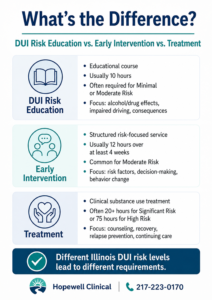
In Illinois, DUI Risk Education, Early Intervention, and Treatment are different requirements tied to the DUI evaluation and risk classification.
The Basic Difference: Education, Early Intervention, and Treatment
The easiest way to understand the difference is to think of the services as three levels of response.
| Requirement | What It Is | Who Commonly Needs It | Typical Purpose |
|---|---|---|---|
| DUI Risk Education | A structured alcohol/drug education course related to impaired driving | Minimal Risk and Moderate Risk DUI clients; also commonly required in broader Secretary of State documentation | Helps the client understand how alcohol/drug use affects driving, decision-making, legal consequences, and future risk |
| Early Intervention | A structured, pre-treatment service focused on risk factors and behavior change | Moderate Risk DUI clients | Helps address risk factors before they develop into a more serious substance use pattern |
| DUI Treatment | Clinical substance use treatment based on assessed need and DUI risk classification | Significant Risk and High Risk DUI clients | Addresses substance use patterns, relapse risk, impaired driving risk, and continuing care needs |
DUI Risk Education is not the same as treatment. Early intervention is also not the same as treatment, although it may include counseling-style discussion and behavior-change planning. Treatment is more clinical and typically involves assessment, treatment planning, individual or group counseling, discharge planning, and continuing care documentation.
Illinois rules define early intervention as services that may be “sub-clinical and pre-diagnostic” and are designed to identify and address risk factors related to substance use or possible future substance use disorder concerns. Treatment, by contrast, is part of a recovery-oriented continuum of care and must be linked to the assessed needs of the patient rather than delivered as a one-size-fits-all program.
Illinois DUI Risk Classifications Determine the Starting Point
An Illinois DUI evaluation is used to determine the person’s DUI risk classification and recommend the appropriate intervention, treatment, or combination of services. Under Illinois Administrative Code Title 77, Part 2060, the evaluator considers information such as DUI history, driving abstract information, chemical test or refusal information, alcohol/drug use history, and symptoms of substance use disorder.
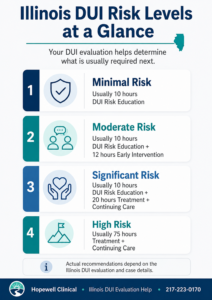
The classifications are generally:
| Illinois DUI Risk Classification | Common Indicators | Minimum Initial Recommendation |
|---|---|---|
| Minimal Risk | No prior qualifying DUI-related history, BAC under .15, no identified impaired-driving pattern, and no other substance use disorder symptoms | Minimum 10 hours DUI Risk Education |
| Moderate Risk | No prior qualifying DUI-related history, BAC .15–.19 or refusal, or at most one substance use disorder symptom | Minimum 10 hours DUI Risk Education plus 12 hours early intervention, no more than 3 hours per day over at least 4 weeks |
| Significant Risk | Prior qualifying DUI-related history and BAC .20 or higher, or two to three substance use disorder symptoms | Minimum 10 hours DUI Risk Education plus 20 hours substance use treatment and continuing care participation |
| High Risk | Two or more qualifying alcohol/drug-related driving incidents, or four or more substance use disorder symptoms | Minimum 75 hours substance use treatment and continuing care participation |
These are minimum starting points, not guarantees that no additional service will ever be recommended. Illinois rules specifically state that the recommended intervention is the minimum necessary and that later information discovered during DUI Risk Education or early intervention may affect recommendations for additional services.
That point matters. A DUI evaluation is not just a formality. If new information emerges—such as undisclosed prior incidents, inaccurate substance use history, a pattern of impaired driving, or symptoms suggesting more serious clinical need—the recommendation may change.
What Is DUI Risk Education in Illinois?
DUI Risk Education in Illinois is a structured alcohol and drug education course focused on impaired driving, substance use, consequences, and personal risk. Illinois rules describe the purpose of DUI Risk Education as providing orientation about the impact of substance use on driving skill and helping the individual explore the personal ramifications of substance use. DUI Risk Education may be provided in person or online when delivered in accordance with Illinois requirements.
DUI Risk Education is often the first requirement people hear about because it applies to Minimal Risk and Moderate Risk classifications. It is also a key Secretary of State requirement. The Illinois Secretary of State states that the DUI Risk Education Course must be completed after the last DUI arrest date and that the requirement cannot be waived for alcohol- and drug-related hearings.
What DUI Risk Education Usually Covers
Although curriculum details can vary by licensed provider, DUI Risk Education generally addresses topics such as:
| Topic Area | Why It Matters |
|---|---|
| Alcohol and drug effects on driving | Helps clients understand impairment beyond “feeling drunk” |
| Blood alcohol concentration and refusal issues | Connects legal facts to personal decision-making |
| Illinois DUI consequences | Clarifies court, licensing, and Secretary of State concerns |
| Decision-making and risk patterns | Helps clients recognize choices that led to the arrest |
| Personal prevention planning | Helps reduce future impaired-driving risk |
Illinois rules require successful completion of DUI Risk Education, including attendance in proper sequence and a post-test score of at least 75%. A DUI Risk Education Certificate of Completion is issued through the state reporting system after successful completion.
What DUI Risk Education Is Not
DUI Risk Education is not the same as counseling or treatment. It is educational, structured, and curriculum-based. It does not necessarily mean a person has a substance use disorder, and it does not replace early intervention or treatment if the evaluation recommends those services.
For example, a Minimal Risk client may only need DUI Risk Education. A Moderate Risk client usually needs DUI Risk Education and early intervention. A Significant Risk client generally needs DUI Risk Education and treatment. High Risk clients typically have a treatment requirement rather than only an education requirement.
What Is Early Intervention for an Illinois DUI?
Early intervention is a structured service generally required for Moderate Risk DUI clients in Illinois. It is designed to address risk factors before they develop into a more serious or persistent substance use problem.
Illinois rules describe early intervention as sub-clinical or pre-diagnostic services that screen, identify, and address risk factors related to substance use disorders. Early intervention is intended to help individuals recognize harmful consequences, develop greater emotional and social stability, and receive referrals for treatment when needed.
For a Moderate Risk DUI classification, Illinois requires a minimum of 12 hours of early intervention, provided no more than 3 hours per day over at least 4 weeks, in addition to the minimum 10 hours of DUI Risk Education.
Why Moderate Risk Clients Receive Early Intervention
A Moderate Risk classification does not automatically mean someone needs full substance use treatment. It does mean the evaluation identified enough risk to require more than education alone.
Common reasons someone may be classified Moderate Risk include:
| Possible Factor | Practical Meaning |
|---|---|
| BAC between .15 and .19 | The arrest involved a higher level of intoxication than Minimal Risk allows |
| Chemical test refusal | The refusal itself may affect classification |
| One symptom of substance use disorder | The evaluation identified at least one clinical risk indicator |
| No prior qualifying DUI history | Moderate Risk can still apply even without a prior DUI |
Early intervention gives the person a structured opportunity to examine what happened, identify risk factors, consider patterns, and develop practical strategies to avoid another impaired-driving incident.
What Happens During Early Intervention?
Early intervention is usually more individualized than DUI Risk Education. It may involve discussion of the DUI event, alcohol/drug use patterns, emotional triggers, social influences, stressors, decision-making, transportation planning, and future risk reduction.
A strong early intervention process should not feel like a generic lecture. It should help the client answer questions such as:
| Question | Why It Matters |
|---|---|
| What circumstances led to the DUI arrest? | Identifies the chain of decisions before the incident |
| Was this truly unusual, or part of a pattern? | Clarifies risk and honesty in the process |
| What situations increase future risk? | Supports prevention planning |
| What needs to change before court, probation, or a hearing? | Connects clinical work to practical requirements |
| Is treatment needed beyond early intervention? | Protects the client and public safety when risk is higher than initially understood |
Illinois rules require early intervention services to relate to the risk factors identified in the ASAM assessment, and the early intervention service plan must identify interventions addressing those risk factors.
What Is DUI Treatment in Illinois?
DUI treatment in Illinois is clinical substance use treatment recommended when the DUI evaluation indicates a higher level of risk or treatment need. It is typically required for Significant Risk and High Risk classifications, though treatment may also be recommended in other situations if clinical information supports it.
Illinois rules describe treatment as part of a recovery-oriented continuum of care. Treatment must be patient-centered, individualized, trauma-informed, and linked to the assessed needs of the patient. Level 1 outpatient treatment includes non-residential clinical services such as assessment, treatment planning, continued assessment, individual or group substance use disorder treatment, and discharge planning.
Treatment Hours for Illinois DUI Classifications
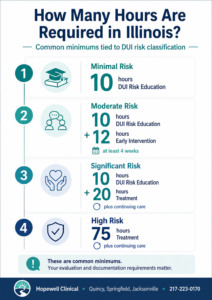
| DUI Risk Level | Minimum Treatment/Education Requirement |
|---|---|
| Significant Risk | Minimum 10 hours DUI Risk Education, minimum 20 hours substance use treatment, and active participation in continuing care after discharge |
| High Risk | Minimum 75 hours substance use treatment, completion of all recommended treatment, and ongoing participation in continuing care after discharge |
The required hours are important, but they are not the whole story. Treatment also involves documentation: assessment information, treatment plans, progress, discharge summaries, continuing care plans, and sometimes continuing care status reports for Secretary of State hearings.
What DUI Treatment Usually Addresses
DUI treatment may focus on:
| Treatment Focus | Examples |
|---|---|
| Substance use patterns | Frequency, quantity, triggers, consequences, changes over time |
| Impaired-driving risk | Past decisions, transportation planning, high-risk situations |
| Relapse prevention | Warning signs, coping skills, support systems |
| Accountability | Honest self-assessment without shame-based avoidance |
| Mental health and stressors | Anxiety, depression, anger, grief, trauma, or life stress when relevant |
| Continuing care | Long-term plan after formal treatment ends |
Treatment does not mean a person is “bad” or beyond help. It means the evaluation identified a need for a more clinical response than education alone.
Court Requirements vs. Secretary of State Requirements
One of the most common mistakes after an Illinois DUI is assuming that court requirements and Secretary of State requirements are identical. They often overlap, but they are not always the same process.
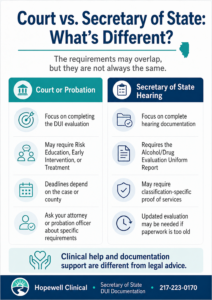
Court or Probation
For court or probation, the focus is usually whether the client completed the DUI evaluation and followed the recommendations tied to the criminal case. Depending on the county, court order, plea agreement, probation conditions, or attorney strategy, the person may need proof of evaluation, risk education, early intervention, treatment, or discharge.
A person should follow the direction of their attorney and probation officer when applicable. Hopewell Clinical can assist with evaluation, treatment, and documentation, but legal strategy should come from an attorney.
Illinois Secretary of State Hearings
For license reinstatement or a Restricted Driving Permit, the documentation standard can be more detailed. The Secretary of State requires an Alcohol/Drug Evaluation Uniform Report completed after the most recent DUI arrest by a licensed DSUPR agency, and the evaluation places the person at a classification level that determines additional documentation requirements.
For example, the Secretary of State lists specific requirements for each classification. Moderate Risk clients need proof of DUI Risk Education and proof of completing Early Intervention, including the number of hours completed, dates of involvement, summary of what was explored and addressed, and outcome of involvement. Significant Risk and High Risk clients generally need treatment documentation such as the individualized treatment plan, discharge summary, aftercare or continuing care plan, and original continuing care status report.
For alcohol- and drug-related hearings, the Secretary of State also warns that incomplete paperwork can prevent the hearing from moving forward.
Online DUI Risk Education, Early Intervention, and Treatment in Illinois
Many clients ask whether they can complete DUI services online in Illinois. The answer depends on the service, the provider’s authorization, the client’s case, and any court or Secretary of State expectations.
Illinois rules allow DUI Risk Education to be provided either in person or online when delivered in accordance with state requirements. Treatment and early intervention may also involve telehealth options when clinically appropriate and properly delivered by an authorized provider.
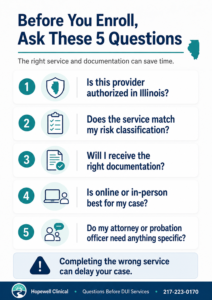
That said, “online” does not mean informal or self-paced in every situation. Clients should verify:
| Online Service Question | Why It Matters |
|---|---|
| Is the provider properly licensed or authorized in Illinois? | Unlicensed services may not be accepted |
| Will the service match my risk classification? | Completing the wrong service can delay court or hearing progress |
| Will I receive the correct documentation? | The Secretary of State often requires specific documents |
| Does my attorney or probation officer approve this plan? | Local court expectations can matter |
| Is telehealth clinically appropriate for my situation? | Higher-risk cases may need closer clinical attention |
Hopewell Clinical provides DUI evaluations, outpatient substance use treatment, continuing care documentation, and appropriate Illinois telehealth services when clinically and administratively suitable. To ask about current availability, call 217-223-0170.
Common Mistakes That Delay DUI Cases in Illinois
Most delays do not happen because a client refuses to cooperate. They usually happen because the client did not know what the system required.
Mistake 1: Calling Everything “DUI Classes”
“DUI classes” can mean different things. A client may think they completed treatment when they only completed Risk Education, or they may think Early Intervention is the same as DUI Risk Education. The safest approach is to look at the Alcohol/Drug Evaluation Uniform Report and identify the actual risk classification and recommendation.
Mistake 2: Completing Services Before the Evaluation Is Clear
Some people try to move quickly and sign up for the first available class. Speed matters, but accuracy matters more. If the service does not match the evaluation recommendation, court order, or Secretary of State requirement, it may not solve the problem.
Mistake 3: Not Keeping Completion Documents
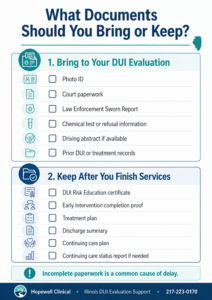
Clients should keep copies of risk education certificates, early intervention completion letters, treatment plans, discharge summaries, aftercare plans, and continuing care reports. The Secretary of State may require original or properly prepared documents depending on the hearing issue and classification.
Mistake 4: Waiting Until the Week Before Court or a Hearing
Moderate Risk early intervention must be completed over at least four weeks. Significant and High Risk treatment takes longer. Waiting too long can create scheduling problems, incomplete documentation, and unnecessary anxiety.
Mistake 5: Assuming a Waiver Is Automatic
Treatment or early intervention may be waived or modified in some circumstances, but clients should not assume this will happen. For Secretary of State hearings, written waiver documentation may be required if early intervention or treatment was waived or modified.
What Documentation Should You Ask For?
The documents you need depend on your risk classification and the purpose of the paperwork.
| Situation | Documents Often Needed |
|---|---|
| Minimal Risk | Alcohol/Drug Evaluation Uniform Report; proof of DUI Risk Education completion |
| Moderate Risk | Uniform Report; proof of DUI Risk Education; Early Intervention completion letter with hours, dates, topics/summary, and outcome |
| Significant Risk | Uniform Report; DUI Risk Education proof; treatment plan; discharge summary; continuing care plan; continuing care status report when needed |
| High Risk | Uniform Report or updated evaluation; treatment documentation; continuing care documentation; support/recovery documentation when required for Secretary of State purposes |
| Secretary of State hearing | Classification-specific documents; updated evaluation if the Uniform Report is more than six months old at the hearing; additional forms depending on classification and hearing type |
The Secretary of State states that if the last Uniform Report is more than six months old at the time of hearing, an Updated Evaluation is required. The rules for who may complete that update vary by classification and service history, so clients should confirm this before scheduling.
Local Help in Quincy, Springfield, Jacksonville, and Illinois Telehealth Areas
Hopewell Clinical helps clients in Quincy, Springfield, Jacksonville, and across the state of Illinois understand and complete DUI-related clinical requirements.
Clients commonly contact Hopewell Clinical because they need:
| Client Need | How Hopewell Clinical Can Help |
|---|---|
| DUI evaluation in Illinois | Evaluation and risk classification support |
| DUI Risk Education questions | Guidance on whether risk education is required and what documentation may be needed |
| Early intervention after Moderate Risk classification | Scheduling and documentation guidance when applicable |
| Outpatient DUI treatment | Clinical treatment for clients with Significant or High Risk recommendations |
| Secretary of State hearing documentation | Help preparing treatment, continuing care, and evaluation-related records |
| License reinstatement or RDP preparation | Clinical documentation support; legal strategy should come from an attorney |
| Telehealth DUI treatment options | Appropriate online treatment options when clinically suitable |
If you need a DUI evaluation before court, probation, attorney review, or a Secretary of State hearing, call Hopewell Clinical at 217-223-0170 to ask about scheduling, required documents, and current availability.
How to Know What You Need Next
The best next step depends on where you are in the process.
If You Have Not Completed a DUI Evaluation Yet
Schedule the evaluation first. Bring your photo ID, court paperwork, Law Enforcement Sworn Report, chemical test or refusal information, driving abstract if available, and any prior DUI or treatment records. Illinois rules identify driving record information and the Law Enforcement Sworn Report as key information used in the DUI evaluation process.
If You Already Have Your Uniform Report
Look for the risk classification and recommended intervention. The report should identify whether you are Minimal, Moderate, Significant, or High Risk and what services are recommended. Illinois rules require the assigned risk level and corresponding intervention to be documented on the Alcohol and Drug Evaluation Uniform Report produced through eDSRS.
If You Are Preparing for a Secretary of State Hearing
Do not assume your old paperwork is enough. Review whether your Uniform Report is more than six months old, whether you need an updated evaluation, whether your treatment documents are complete, and whether your letters or continuing care status report meet current requirements. The Secretary of State specifically warns applicants to be completely prepared because incomplete paperwork can prevent the hearing from moving forward.
If You Are Unsure Whether You Need Treatment
Do not guess. Ask the evaluator, treatment provider, attorney, or probation officer to clarify the requirement. Completing extra services may not harm the case, but completing the wrong service or failing to complete the required one can cause delay.
DUI Risk Education vs. Early Intervention vs. Treatment: The Bottom Line
DUI Risk Education, early intervention, and treatment all serve different purposes in Illinois DUI cases.
DUI Risk Education is educational and is commonly required for Minimal and Moderate Risk cases. Early intervention is a structured risk-focused service generally connected to Moderate Risk cases. Treatment is a clinical service required when the evaluation indicates Significant Risk, High Risk, or another level of treatment need.
The most important thing is to match the service to the evaluation, court order, and Secretary of State requirement. A client who understands the difference can avoid wasted time, incomplete paperwork, and unnecessary stress.
For help with an Illinois DUI evaluation, DUI treatment, early intervention questions, or Secretary of State documentation, call Hopewell Clinical at 217-223-0170.
FAQ: DUI Risk Education, Early Intervention, and Treatment in Illinois
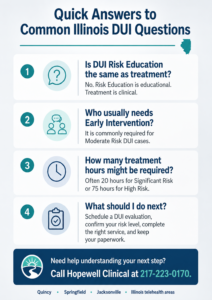
Is DUI Risk Education the same as treatment in Illinois?
No. DUI Risk Education is a structured education course about substance use and impaired driving. Treatment is a clinical service that addresses substance use patterns, risk, recovery planning, and continuing care needs.
How many hours is DUI Risk Education in Illinois?
Illinois requires a minimum of 10 hours of DUI Risk Education for Minimal Risk cases and as part of the Moderate Risk requirement. Significant Risk cases also include DUI Risk Education along with treatment.
How many hours is early intervention for a Moderate Risk DUI in Illinois?
Moderate Risk DUI clients are generally required to complete 12 hours of early intervention in addition to 10 hours of DUI Risk Education. The early intervention must be provided no more than 3 hours per day over at least 4 weeks.
How many treatment hours are required for Significant Risk or High Risk DUI in Illinois?
Significant Risk generally requires a minimum of 20 hours of substance use treatment, plus DUI Risk Education and continuing care. High Risk generally requires a minimum of 75 hours of substance use treatment and ongoing continuing care participation after discharge.
By Hopewell Clinical
Reviewed by Matt Dutton, BA, CADC