
Quick Summary
An Illinois DUI evaluation is often required when you are seeking license reinstatement or a Restricted Driving Permit through the Illinois Secretary of State after a DUI-related revocation or suspension. The Secretary of State generally wants to see a current Alcohol/Drug Evaluation Uniform Report, documentation tied to your DUI risk classification, proof of DUI Risk Education, treatment records when required, and updated reports if your evaluation is more than six months old at the time of hearing. Hopewell Clinical helps clients in Quincy, Springfield, Jacksonville, and across the state of Illinois prepare clinical documentation for Secretary of State DUI hearings. Call 217-223-0170 to ask about scheduling and required documents.
Why the DUI Evaluation Matters for Illinois License Reinstatement
When someone searches for Illinois license reinstatement DUI evaluation or Secretary of State DUI hearing documentation, they are usually not looking for a generic explanation of a DUI case. They are trying to figure out what the Secretary of State needs before they can move forward with driving relief.
That distinction matters.
A DUI evaluation for court may help address sentencing, probation, or court-ordered services. A DUI evaluation for Illinois Secretary of State license reinstatement is also used to evaluate public safety risk, document compliance, and support the hearing officer’s review of whether the person has addressed the alcohol- or drug-related concerns connected to the loss of driving privileges.
Hopewell Clinical does not provide legal advice, represent clients at hearings, or guarantee reinstatement. Those questions should be discussed with an attorney or the Secretary of State hearing officer. What Hopewell Clinical can do is help with the clinical side: DUI evaluations, updated evaluations when appropriate, treatment documentation, continuing care status reports, treatment verification support, and related records commonly needed for a Secretary of State hearing.
If your hearing is approaching, the most important question is not simply, “Did I complete treatment?” It is, “Is my documentation complete, current, consistent, and responsive to my risk classification and hearing issue?”
What the Illinois Secretary of State Usually Wants to See
For DUI-related driving relief, the Secretary of State generally focuses on whether your documentation shows three things:
- A valid, current DUI evaluation and risk classification
- Completion of required education, early intervention, treatment, or continuing care
- Evidence that the underlying alcohol- or drug-related driving risk has been addressed
The central document is the Alcohol/Drug Evaluation Uniform Report. This report is generated through the Illinois DUI reporting system and identifies the DUI risk classification and recommended intervention or treatment. Depending on your classification, additional documents may be required.
The Secretary of State may also require an Updated Evaluation if your last Uniform Report or updated evaluation is more than six months old at the time of your hearing. This is one of the most common reasons people discover their packet is not ready.
Core Documents to Ask About Before Your Hearing
| Document | Why It Matters |
|---|---|
| Alcohol/Drug Evaluation Uniform Report | Establishes the DUI risk classification and recommendations |
| Updated Evaluation | Often required if the prior evaluation is more than six months old at hearing |
| DUI Risk Education Certificate | Required for many DUI classifications and generally cannot be waived |
| Individualized Treatment Plan | Shows what treatment goals and issues were addressed |
| Discharge Summary | Documents completion, progress, prognosis, and discharge status |
| Continuing Care Plan | Shows what support or follow-up was recommended after treatment |
| Continuing Care Status Report | Shows whether continuing care is active, completed, waived, or incomplete |
| Treatment Verification form | Helps document treatment completion for Secretary of State purposes |
| Abstinence or support letters | Often important for High Risk cases, especially dependent classifications |
| Prior denial or BAIID-related documents | May need to be addressed directly if there was a previous denial or violation issue |
This is why people often need more than “a DUI evaluation near me.” For reinstatement, the evaluation is part of a larger documentation packet.
The Alcohol/Drug Evaluation Uniform Report
The Alcohol/Drug Evaluation Uniform Report is not just a formality. It summarizes the evaluator’s clinical review and risk assignment. It generally includes information related to:
- alcohol and drug use history from first use to present;
- the DUI arrest and chemical test or refusal information;
- prior alcohol- or drug-related driving incidents;
- prior treatment or recovery involvement;
- objective testing;
- driving record information;
- collateral or significant-other information when required;
- risk classification; and
- recommended education, intervention, treatment, or continuing care.
For a Secretary of State hearing, the evaluation should be complete, internally consistent, and based on accurate records. Problems can occur when a client forgets prior arrests, does not disclose old evaluations, lacks the Law Enforcement Sworn Report, or gives a substance use history that does not match other records. These issues do not always mean the person is being dishonest. Many DUI cases involve old dates, confusing dispositions, or records from another county or state. Still, inconsistencies can slow the process and may need to be clarified before hearing.
Practical Preparation Tip
Before scheduling or updating a DUI evaluation for license reinstatement, gather as many of the following as possible: 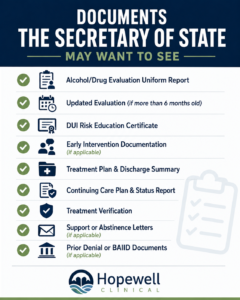
- photo ID;
- Law Enforcement Sworn Report;
- chemical test result or refusal information;
- court disposition or sentencing documents;
- prior DUI evaluations;
- treatment completion records;
- DUI Risk Education certificate;
- driving abstract or Court Purposes Driving Abstract, if available;
- Secretary of State denial letters, if any;
- BAIID violation or rejection letters, if any;
- probation or attorney referral paperwork; and
- any continuing care or recovery-support documentation.
If you are unsure what you need, call Hopewell Clinical at 217-223-0170 and ask what documents to bring or send before your appointment.
Illinois DUI Risk Classifications and Why They Matter
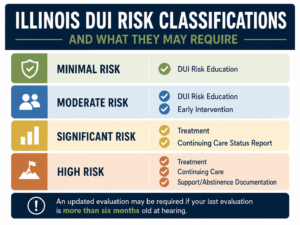
Illinois DUI evaluations classify risk using categories such as Minimal Risk, Moderate Risk, Significant Risk, and High Risk. The classification affects what the Secretary of State expects to see. A person should not try to predict their own classification based only on BAC or number of arrests. The evaluator reviews multiple sources of information, and the classification may be affected by driving history, chemical test information, substance use symptoms, prior DUI dispositions, prior suspensions, and other clinical data.
Updated DUI Evaluations: The Six-Month Problem
One of the most common problems in license reinstatement cases is timing. A person may complete an Illinois DUI evaluation, finish treatment, and assume the packet is finished. Then, by the time the hearing occurs, the evaluation may be considered too old.
For Secretary of State purposes, if the Uniform Report or last updated evaluation is more than six months old at the time of the hearing, an Updated Evaluation may be required.
This does not mean the entire process starts over in the same way. An updated evaluation is typically used to review current status, update alcohol and drug use information, confirm whether new legal or driving issues have occurred, and assess whether prior recommendations remain appropriate. However, the updated evaluation must be completed by an appropriate provider. In some cases, the agency that completed the original Uniform Report or the treatment agency may need to complete the update. Moderate Risk cases have specific limitations about who may complete the updated evaluation.
This is a detail people often miss. Waiting until the week before a hearing can create avoidable stress if the correct agency is unavailable, records need to be transferred, or the prior evaluation file is incomplete.
Practical Rule
If your hearing date is scheduled, check the date of your most recent Uniform Report or updated evaluation immediately. If it will be more than six months old on the hearing date, call the evaluation provider as soon as possible.
Court Requirements vs. Secretary of State Requirements
A common misunderstanding is that completing court requirements automatically satisfies the Secretary of State. It may not.
The court and the Secretary of State may be looking at overlapping information, but they are not always asking the same question.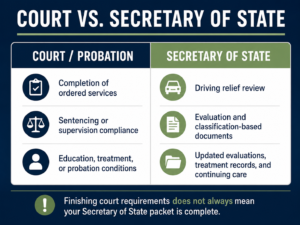
Court, Probation, and Sentencing
The court may focus on whether the person completed the DUI evaluation, Risk Education, treatment, probation conditions, fines, victim impact panel, or other sentencing requirements. Probation may focus on compliance with court orders and supervision conditions.
Secretary of State Hearing
The Secretary of State focuses on driving relief. That may include whether the person has addressed the alcohol- or drug-related risk connected to driving, whether the required documentation is complete, and whether the person can demonstrate readiness for a Restricted Driving Permit or full reinstatement.
Attorney Referral
An attorney may want the documentation reviewed before hearing to make sure it is consistent with the legal strategy and hearing requirements. Hopewell Clinical can help prepare clinical records, but legal strategy should come from the attorney.
Why This Difference Matters
Someone may truthfully say, “I finished everything the court ordered,” but still be missing a Secretary of State document. For example, the person may need an updated evaluation, original continuing care status report, treatment verification, abstinence letters, support letters, or a response to a previous denial.
Treatment Records the Secretary of State May Review
For Significant Risk and High Risk classifications, treatment documentation becomes especially important. The Secretary of State may want more than a simple completion certificate. The packet may need to show what the client addressed, how treatment reduced risk, and what continuing care recommendations remain.
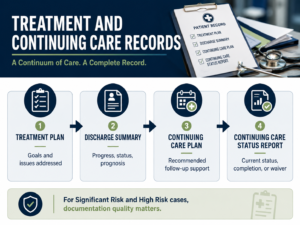
Common treatment records include:
- Individualized Treatment Plan
This shows the goals, objectives, and issues addressed in treatment. - Discharge Summary
This explains the reason for discharge, progress toward treatment goals, condition at discharge, prognosis, and continuing care recommendations. - Continuing Care Plan
This describes recommended follow-up after discharge, such as recovery support, counseling, relapse prevention planning, accountability supports, or other clinically appropriate steps. - Continuing Care Status Report
This documents whether the client is currently active in continuing care, completed it, failed to complete it, or had continuing care waived with rationale. - Treatment Verification
This is often used to document treatment completion and attach supporting records.
A strong clinical packet is not about exaggerating progress or trying to “say the magic words.” It should accurately document what occurred, what the client gained, what risks were addressed, and what supports are in place now.
Continuing Care Status Reports: Why They Matter
A Continuing Care Status Report is often a key piece of Secretary of State DUI hearing documentation. It may help answer questions such as:
- Did the client follow through after treatment?
- Is the client still involved in continuing care?
- Was continuing care completed?
- Was continuing care waived, and if so, why?
- What is the client’s current prognosis?
- Has the client maintained stability since discharge?
- Are there unresolved concerns that need additional treatment or support?
A weak continuing care report can create problems even when the client completed the required number of hours. The report should be specific enough to explain treatment gains and current functioning without overstating conclusions. It should also match the rest of the record. For example, if the discharge summary recommends ongoing support, the continuing care status report should explain whether that support occurred and what the outcome was.
Hopewell Clinical regularly assists clients with continuing care documentation for Illinois DUI and Secretary of State purposes. To ask about your case, call 217-223-0170.
High Risk Cases: Abstinence, Support, and Documentation
High Risk cases often require more extensive documentation. Depending on the facts and classification, the Secretary of State may expect documentation of treatment completion, continuing care, support or recovery involvement, abstinence, or a current non-problematic use pattern.
High Risk documentation can be especially sensitive because the hearing officer may be looking for consistency across several sources:
- the evaluation;
- the treatment records;
- the client’s testimony;
- support letters;
- abstinence letters;
- prior denial letters;
- BAIID records, if applicable;
- criminal or driving history; and
- continuing care reports.
Letters Should Be Current and Specific
In many cases, letters used for Secretary of State hearings must be signed and dated within a certain timeframe before the hearing. The content should be specific, not generic. A letter that says, “He is a good person and deserves his license back” is usually less helpful than a letter that clearly describes the person’s observed abstinence, recovery involvement, current alcohol or drug use pattern, contact frequency, and behavioral changes.
Support Does Not Always Mean AA
Some people participate in Alcoholics Anonymous or another structured recovery group. Others may rely on counseling, church involvement, recovery coaching, family accountability, sober peers, or other non-traditional supports. The key is that the support should be credible, documented, and consistent with the person’s classification and clinical recommendations.
Prior Denials: What Needs to Change Before the Next Hearing?
A prior denial can be frustrating, but it can also provide a roadmap. The denial letter may identify unresolved concerns that need to be addressed before the next hearing.
Common reasons a person may need additional documentation after a denial include:
- the evaluation did not fully address alcohol or drug use history;
- treatment records were incomplete;
- continuing care was not documented;
- abstinence or support letters were insufficient;
- BAIID violations were not explained;
- testimony conflicted with the evaluation;
- a prior arrest, refusal, or suspension was omitted;
- the person did not provide records requested by the evaluator;
- the hearing officer wanted additional treatment or clarification; or
- the person applied too soon or with incomplete paperwork.
If you were denied, bring the denial letter to your evaluator or treatment provider. Do not rely on memory alone. The provider may need to address the specific concerns raised by the Secretary of State.
BAIID, Restricted Driving Permits, and Clinical Documentation
Some people seeking driving relief may be applying for a Restricted Driving Permit Illinois option, and some may be required to use a BAIID Illinois device depending on their history and permit type. BAIID issues are not only administrative. They can also become clinical documentation issues if the Secretary of State asks the petitioner to explain a violation, failed test, missed retest, tampering allegation, or alcohol-related concern.
If a BAIID issue contributed to a denial or delay, the treatment provider may need to review the relevant letter or rejection notice. The clinical documentation should not guess. It should address the specific concern, discuss whether it changes the clinical impression, and identify whether additional treatment or support is recommended.
Again, legal strategy belongs with the attorney. Clinical documentation should remain accurate, grounded, and within the provider’s role.
Online DUI Evaluations and Telehealth Considerations in Illinois
Many people search for online DUI evaluation Illinois or DUI treatment online Illinois because they live in rural areas, work long hours, lack transportation, or are trying to complete documentation before a hearing. Online and telehealth options may be available in appropriate circumstances, but acceptance can depend on the service, provider licensing, court rules, Secretary of State requirements, and the facts of the case.
For DUI evaluations, the provider must still verify identity, obtain required information, observe client presentation, and complete the evaluation in a manner consistent with Illinois requirements. For Risk Education or treatment, online options may be available through properly authorized providers when permitted.
Before assuming an online option will work, ask three questions:
- Is the provider properly licensed or authorized for the DUI service?
- Will the documentation be accepted for the intended purpose?
- Are there any court, probation, attorney, or Secretary of State instructions that limit where or how the service must be completed?
Hopewell Clinical provides services in Quincy and appropriate Illinois telehealth areas. Call 217-223-0170 to ask whether telehealth is appropriate for your situation.
Common Documentation Mistakes That Delay Reinstatement
A strong Secretary of State packet is not only about having the right documents. It is also about avoiding common mistakes.
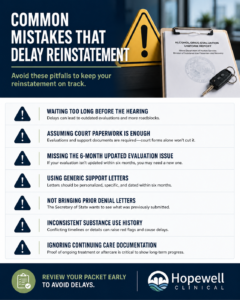
Mistake 1: Waiting Until the Hearing Is Too Close
Updated evaluations, continuing care reports, treatment verification forms, and support letters may take time. If the hearing is soon, the provider may not have enough time to review records, complete the evaluation properly, or correct missing information.
Mistake 2: Assuming the Court Packet Is Enough
Court completion paperwork may not include everything needed for Secretary of State driving relief.
Mistake 3: Missing the Six-Month Update Requirement
If the evaluation is too old at the time of hearing, an updated evaluation may be needed.
Mistake 4: Using Generic Support Letters
Letters should be current, specific, signed, dated, and written by people who can credibly describe the person’s behavior, abstinence, recovery involvement, or current use pattern.
Mistake 5: Not Bringing Prior Denial Letters
If the Secretary of State previously denied driving relief, that denial may need to be addressed directly.
Mistake 6: Inconsistent Substance Use History
The evaluation, treatment records, letters, and testimony should not tell different stories. If there are inconsistencies, discuss them honestly with the evaluator.
Mistake 7: Missing Original or Properly Completed Forms
Some documents may need original signatures, specific forms, agency letterhead, or complete attachments.
Mistake 8: Ignoring Continuing Care
Continuing care is not always a minor afterthought. In many reinstatement cases, it helps show whether treatment gains were maintained after discharge.
Local DUI Evaluation and Reinstatement Documentation Support
Hopewell Clinical is based in Quincy, Illinois and Springfield, Illinois and works with DUI clients across the state through telehealth services.
Many clients contact Hopewell Clinical because they are preparing for:
- an Illinois DUI evaluation;
- an updated DUI evaluation;
- Secretary of State DUI hearing documentation;
- Illinois license reinstatement help;
- Restricted Driving Permit documentation;
- BAIID-related documentation questions;
- continuing care status reports;
- treatment verification;
- attorney-requested records;
- probation compliance documentation; or
- DUI treatment online Illinois options.
Hopewell Clinical cannot promise reinstatement or tell you what the hearing officer will decide. What the agency can do is help you understand the clinical documentation process, identify what records may be needed, and complete services within the appropriate Illinois DUI evaluation and treatment framework.
If you need a DUI evaluation before a Secretary of State hearing, license reinstatement request, attorney review, probation matter, or Restricted Driving Permit application, call Hopewell Clinical at 217-223-0170 to ask about scheduling, documentation, and current availability.
What to Do Before You Call
To make the first call more productive, gather what you have. You do not need to have everything perfectly organized before reaching out, but the more information you can provide, the easier it is to identify what may be missing.
Reinstatement Documentation Checklist
Bring or ask about:
- photo ID;
- most recent DUI arrest paperwork;
- Law Enforcement Sworn Report;
- chemical test or refusal information;
- court disposition documents;
- probation paperwork, if applicable;
- prior Alcohol/Drug Evaluation Uniform Report;
- prior updated evaluation, if applicable;
- DUI Risk Education completion certificate;
- treatment plan;
- discharge summary;
- continuing care plan;
- continuing care status report;
- treatment verification form;
- prior Secretary of State denial letter;
- BAIID violation or rejection letter, if applicable;
- letters documenting abstinence, support, or current use pattern;
- attorney instructions, if represented; and
- hearing date, if scheduled.
If you do not have a document, say so. Sometimes the next step is simply identifying where the document can be obtained.
Final Thoughts
A DUI evaluation for Illinois license reinstatement is not just an appointment. It is part of a larger process that may include risk classification, education, treatment, continuing care, updated evaluations, and Secretary of State hearing documentation. The stronger your documentation is, the easier it is for your attorney, evaluator, treatment provider, and hearing officer to understand what has been completed and what still needs attention.
The best time to review your packet is before the hearing is close. Waiting until the last week can create unnecessary delays, especially if an updated evaluation, continuing care report, treatment verification, support letters, or denial-response documentation is needed.
If you need an Illinois DUI evaluation, updated evaluation, continuing care status report, or Secretary of State DUI hearing documentation, call Hopewell Clinical at 217-223-0170. Hopewell Clinical serves the entire state of Illinois and can assist on your goal .
FAQ
Do I need a DUI evaluation for Illinois license reinstatement?
In many DUI-related reinstatement cases, yes. The Illinois Secretary of State generally requires an Alcohol/Drug Evaluation Uniform Report and may require additional documentation depending on your DUI risk classification, treatment history, and hearing purpose.
How old can my DUI evaluation be for a Secretary of State hearing?
If your Uniform Report or last updated evaluation is more than six months old at the time of your hearing, you may need an updated evaluation. Because timing can affect your packet, check the evaluation date as soon as your hearing is scheduled.
What documents are needed for a Secretary of State DUI hearing?
Common documents include the Alcohol/Drug Evaluation Uniform Report, proof of DUI Risk Education, updated evaluation if needed, early intervention or treatment records, individualized treatment plan, discharge summary, continuing care plan, continuing care status report, treatment verification, and support or abstinence letters when required.
Can Hopewell Clinical help with Secretary of State DUI hearing documentation?
Yes. Hopewell Clinical can help with DUI evaluations, updated evaluations when appropriate, outpatient treatment documentation, continuing care status reports, and related clinical records. Hopewell Clinical does not provide legal representation or guarantee reinstatement, so legal strategy should be discussed with an attorney.
Written by Hopewell Clinical
Reviewed by Matt Dutton, BA, CADC