

Quick Summary
An Illinois DUI evaluation is a required alcohol and drug evaluation used to determine your DUI risk classification and what DUI Risk Education, early intervention, treatment, or continuing care may be required. The evaluation reviews your driving history, chemical test results, objective test results, and an interview about your alcohol and drug use history.
For your appointment, you should bring a court paperwork, Law Enforcement Sworn Report, chemical test or refusal information, driving abstract, and any prior DUI evaluation or treatment records. Hopewell Clinical provides DUI evaluations in Quincy, Springfield, and Jacksonville, IL, and across the state through telehealth options.
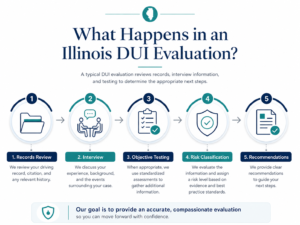
What Is a DUI Evaluation in Illinois?
A DUI evaluation in Illinois is a structured alcohol and drug assessment required after a DUI arrest. Its purpose is to determine the extent of a person’s alcohol or drug use and whether that use creates risk to current or future public safety. The evaluation is used to assign a DUI risk classification and recommend the appropriate level of education, early intervention, treatment, or continuing care.
In practical terms, the DUI evaluation answers several important questions:
- Was this an isolated alcohol- or drug-related driving incident, or is there a broader pattern?
- What does the person’s driving history show?
- What were the BAC, chemical test, THC, or refusal details?
- Do objective test results suggest elevated risk?
- Does the person need DUI Risk Education, early intervention, outpatient treatment, or continuing care?
- Is the documentation sufficient for court, probation, attorney review, or the Illinois Secretary of State?
The results are documented on the Alcohol/Drug Evaluation Uniform Report, which is the official Illinois DUI evaluation report used by the court or the Illinois Secretary of State. Illinois Administrative Code, Title 77, Part 2060 requires the evaluation summary, assigned risk level, and corresponding intervention to be documented on the IDHS/DBHR Alcohol and Drug Evaluation Uniform Report through the electronic DUI reporting system.
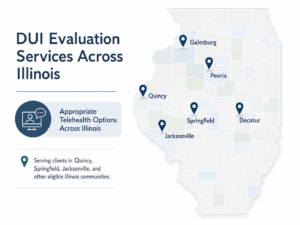
Hopewell Clinical provides DUI evaluations for clients in Quincy, Springfield, Jacksonville, Galesburg, Bloomington, Decatur, Peoria and across the state of Illinois through telehealth.
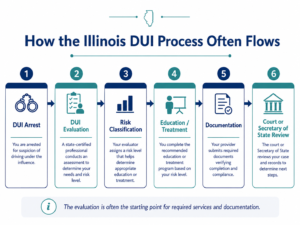
Why a DUI Evaluation Matters After a DUI Arrest
Many people think of the DUI evaluation as paperwork. That is understandable, especially when the court, attorney, or probation officer simply says, “You need to get evaluated.” But the evaluation can shape several parts of the DUI process.
A DUI evaluation may affect:
- What the court requires before sentencing or supervision
- Whether DUI Risk Education is required
- Whether early intervention or treatment is required
- Whether continuing care is needed after treatment
- What documentation is needed for probation
- What records may later be needed for license reinstatement
- Whether a Secretary of State hearing packet is complete
- Whether restricted or full driving privileges can move forward
Illinois DHS explains that anyone arrested for DUI must complete an alcohol and drug evaluation before sentencing can occur or before restricted or full driving privileges may be granted by the Illinois Secretary of State.
That means the evaluation is not just a clinical form. It connects the legal case, substance use history, driving record, treatment requirements, and public safety concerns.
Court DUI Evaluation vs. Secretary of State DUI Evaluation
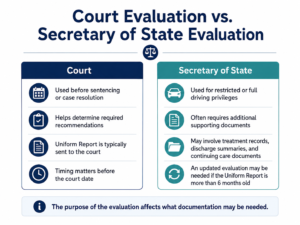
One of the most common points of confusion is whether a DUI evaluation is being completed for court or for the Illinois Secretary of State.
The evaluation process may look similar, but the purpose can be different.
DUI evaluation for court
A court-related DUI evaluation is usually completed before sentencing, court supervision, probation, or another court outcome. The court uses the evaluation to understand the person’s risk level and determine what education or treatment requirements should be ordered.
Illinois rules state that DUI evaluations should be completed so the Alcohol/Drug Evaluation Uniform Report can be sent directly to the referring circuit court at least five calendar days before the court date unless local rules provide otherwise.
DUI evaluation for license reinstatement
A Secretary of State-related DUI evaluation is used when someone is seeking a Restricted Driving Permit, full reinstatement, or other driving relief after a DUI-related revocation. In these cases, the evaluation becomes part of a broader hearing packet.
The Secretary of State may review the Uniform Report, DUI Risk Education records, treatment completion records, discharge summaries, continuing care plans, Continuing Care Status Reports, support letters, abstinence documentation, prior denial letters, and other documents depending on the person’s risk classification.
This distinction matters because a person may complete an evaluation for court and later discover that additional documentation is needed for license reinstatement. The evaluation is often the beginning of the process, not the end.
What Does the Evaluator Review?
An Illinois DUI evaluation is based on multiple sources of information. The evaluator does not rely only on the client’s interview. Illinois DHS identifies several areas that are reviewed, including the person’s driving history, chemical test results, objective test score and category, and the interview with the evaluator.
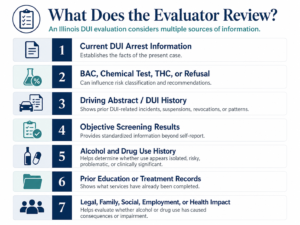
This is why honesty and consistency are important. If the interview, driving abstract, chemical test results, objective test results, or prior records do not match, the evaluator may need to resolve those inconsistencies. Unresolved inconsistencies can create problems later in court or at a Secretary of State hearing.
What Should I Bring to a DUI Evaluation in Illinois?
You should bring as much documentation as possible. Missing records are one of the most common reasons DUI evaluations are delayed.
For a court-related DUI evaluation, bring:
- DUI ticket or arrest paperwork
- Court paperwork
- Law Enforcement Sworn Report
- BAC, chemical test, THC, or refusal information
- Driving abstract or Court Purposes Driving Abstract, if available
- Prior DUI evaluations
- Prior DUI Risk Education records
- Prior early intervention or treatment records
- Attorney or probation paperwork, if applicable
For a Secretary of State or license reinstatement case, also bring:
- Prior Alcohol/Drug Evaluation Uniform Reports
- Prior denial letters
- Discharge summaries
- Treatment verification letters
- Continuing care plans
- Continuing Care Status Reports
- BAIID documents or violation notices
- Support letters or abstinence verification letters, if applicable
- Any previous Secretary of State hearing documents
A simple rule is this: bring more documentation than you think you need. A complete file helps the evaluator prepare a more accurate report and may reduce delays before court, probation, attorney review, or a Secretary of State hearing.
What Is the Alcohol/Drug Evaluation Uniform Report?
The Alcohol/Drug Evaluation Uniform Report is the official Illinois DUI evaluation report. It summarizes the evaluation findings, assigned risk level, and recommended intervention. Illinois Administrative Code, Title 77, Part 2060 states that the evaluation summary, assigned risk level, and intervention must be documented on the IDHS/DBHR Alcohol and Drug Evaluation Uniform Report produced through the state’s DUI reporting system.
This report is important because it may be used by:
- The circuit court
- Probation
- DUI attorneys
- The Illinois Secretary of State
- Hearing officers
- Treatment providers
- License reinstatement documentation reviewers
The Uniform Report is not the same thing as treatment documentation. If the evaluation recommends DUI Risk Education, early intervention, outpatient treatment, or continuing care, separate proof of completion may be required.
For example, if someone is classified as Significant Risk, the Uniform Report may identify the treatment recommendation, so the person will still need documentation showing that the recommended treatment was completed.
Illinois DUI Risk Classifications
After the evaluation is completed, the evaluator assigns one of four DUI risk classifications. These classifications determine the minimum intervention requirements under Illinois rules.
| Illinois DUI Risk Level | Minimum Requirement |
| Minimal Risk | At least 10 hours of DUI Risk Education |
| Moderate Risk | At least 10 hours of DUI Risk Education and at least 12 hours of early intervention over a minimum of four weeks |
| Significant Risk | At least 10 hours of DUI Risk Education and at least 20 hours of substance use treatment |
| High Risk | At least 75 hours of substance use treatment and continuing care after discharge |
The risk classification is not based on one factor alone. It may be influenced by the current DUI arrest, BAC or refusal information, prior DUI-related history, objective test results, substance use history, symptoms of substance use disorder, and whether there are signs of continued risk.
This is where many people become frustrated. A client may feel that the DUI was a one-time mistake, but the evaluation process looks at the broader record. The evaluator’s role is to assess risk, document findings accurately, and recommend the level of intervention required under Illinois standards.
Minimal Risk DUI Evaluation
A Minimal Risk classification generally applies when the evaluation indicates the lowest level of DUI-related risk. The minimum requirement is 10 hours of DUI Risk Education.
DUI Risk Education is not treatment. It is an educational program focused on alcohol, drugs, impaired driving, decision-making, legal consequences, and risk reduction.
A Minimal Risk client may still need to complete the education requirement and provide proof of completion to the court or Secretary of State.
Moderate Risk DUI Evaluation
A Moderate Risk classification requires at least 10 hours of DUI Risk Education and at least 12 hours of early intervention over a minimum of four weeks.
Early intervention is more individualized than DUI Risk Education. It is often used when a person’s alcohol or drug use does not necessarily require full treatment but does suggest risky patterns that need to be addressed.
For many clients, early intervention focuses on decision-making, substance use patterns, triggers, consequences, and strategies to avoid future impaired driving.
Significant Risk DUI Evaluation
A Significant Risk classification requires at least 10 hours of DUI Risk Education and at least 20 hours of substance use treatment.
This classification usually reflects more serious concern than Minimal or Moderate Risk. The issue may involve prior history, elevated objective test results, substance use consequences, symptoms of a substance use disorder, or other risk factors.
Treatment may include individual counseling, group counseling, relapse prevention planning, education, and work on behavioral patterns related to alcohol or drug use.
High Risk DUI Evaluation
A High Risk classification requires at least 75 hours of substance use treatment and ongoing participation in continuing care after discharge.
High Risk cases are often more complex. They may involve multiple DUI-related incidents, more severe alcohol or drug use patterns, prior treatment history, relapse concerns, or other clinical factors. For Secretary of State hearings, High Risk cases may also require more detailed documentation regarding recovery, abstinence, non-problematic use, support systems, and continuing care participation.
For clients seeking Illinois license reinstatement, High Risk documentation must be especially consistent and complete.
Can I Complete a DUI Evaluation Online in Illinois?
In many cases, yes. Illinois DUI evaluations, DUI counseling, early intervention, and outpatient substance use treatment may be available through appropriate telehealth processes.
However, an online DUI evaluation in Illinois must still be completed properly. Illinois Administrative Code requires DUI evaluation services to include the ability to observe client behavior and verify the identity of the client through picture identification.
That means an online evaluation still requires:
- Identity verification
- Client observation
- A structured interview
- Review of driving history and DUI-related documents
- Objective testing
- Proper completion of the Uniform Report
- Appropriate recommendations based on Illinois rules
Online DUI evaluation and online DUI treatment may be helpful for clients who live in rural areas, lack transportation, work irregular hours, have childcare obligations, or live outside Quincy, Springfield, or Jacksonville but still need Illinois DUI services.
Hopewell Clinical provides in-person and appropriate telehealth services for clients in Quincy, Springfield, Jacksonville, Peoria, Decatur, Galesburg, Bloomington-Normal, Macomb, Champaign, Paxton, Lincoln, Carbondale, and other eligible areas of Illinois.
How Soon Should I Schedule a DUI Evaluation Before Court?
Schedule your DUI evaluation as early as possible. Waiting until the last minute can create avoidable problems.
Illinois rules indicate that the evaluation should be completed so the Uniform Report can be sent to the referring circuit court at least five calendar days before the court date, unless a local court rule says otherwise.
You should not wait until a few days before court if you can avoid it. The provider may need time to:
- Schedule the appointment
- Review your documents
- Obtain missing information
- Complete objective testing
- Clarify inconsistencies
- Prepare the Uniform Report
- Obtain required signatures
- Submit the report properly
If you have an upcoming court date, attorney meeting, probation appointment, or Secretary of State hearing, scheduling early gives you the best chance of avoiding delays.
Common Reasons DUI Evaluations Get Delayed
DUI evaluation delays are usually caused by missing or inconsistent information rather than the interview itself.
Common delay issues include:
| Delay Issue | Why It Causes Problems |
| Missing Law Enforcement Sworn Report | The evaluator may need BAC, chemical test, or refusal information |
| No driving abstract | Prior alcohol/drug-related driving history may need verification |
| Missing court paperwork | The provider may not know where the report must be sent |
| Prior treatment records unavailable | Completion of previous services cannot be verified |
| Old Uniform Report | Secretary of State may require an updated evaluation |
| Conflicting alcohol/drug history | Inconsistencies may need to be clarified |
| Client unsure whether the evaluation is for court or reinstatement | Different documentation may be needed |
| Last-minute scheduling | There may not be enough time to complete and submit the report |
The best way to avoid delays is to be organized, bring complete documentation, and explain clearly whether the evaluation is for court, probation, attorney review, license reinstatement, a Restricted Driving Permit, or a BAIID-related issue.
DUI Evaluation for Illinois License Reinstatement
A DUI evaluation for license reinstatement often requires more planning than a basic court evaluation. If your license has been revoked, you may need to appear before the Illinois Secretary of State before driving privileges can be restored.
Depending on the case, you may need:
- Alcohol/Drug Evaluation Uniform Report
- Updated Evaluation, if the original report is too old
- Proof of DUI Risk Education
- Proof of early intervention
- Treatment verification
- Individualized treatment plan
- Discharge summary
- Continuing care plan
- Continuing Care Status Report
- Support letters
- Abstinence letters
- BAIID records
- Prior denial letter responses
The Secretary of State’s administrative hearing process is document-heavy. Missing, outdated, or inconsistent documentation can lead to delays or denial.
If you were previously denied at a Secretary of State hearing, the denial letter is especially important. It usually identifies the hearing officer’s concerns. Those concerns should be addressed directly before the next hearing rather than ignored or treated as a formality.
Hopewell Clinical helps clients prepare the clinical side of Secretary of State DUI hearing documentation, including updated evaluations, treatment verification, discharge summaries, continuing care reports, and related license reinstatement records.
How a DUI Evaluation Fits Into the Bigger Illinois DUI Process
The DUI evaluation is only one step in the larger process. A typical path may look like this:
- DUI arrest
- Attorney consultation
- Court date or probation instruction
- DUI evaluation
- Risk classification assigned
- DUI Risk Education, early intervention, treatment, or continuing care completed
- Documentation submitted to court, probation, attorney, or Secretary of State
- Case resolution or license reinstatement process continues
For some clients, this process is fairly straightforward. For others, especially those with multiple DUIs, prior treatment, old records, or license revocation issues, the process can be more complicated.
This is why it is helpful to work with a provider that understands both the clinical requirements and the documentation expectations involved in Illinois DUI cases.
Local DUI Evaluation Help in Quincy, Springfield, Jacksonville, and Across Illinois
Hopewell Clinical serves clients who need DUI evaluations, substance use assessments, DUI counseling, outpatient treatment, continuing care documentation, and Illinois license reinstatement help.
Clients commonly contact Hopewell Clinical from:
- Quincy and Adams County
- Springfield and Sangamon County
- Jacksonville and Morgan County
- Peoria and Peoria County
- Decatur and Macon County
- Galesburg and Knox County
- Bloomington-Normal and McLean County
- Macomb and McDonough County
- Pittsfield and Pike County
- Beardstown and Cass County
- Lincoln and Logan County
- Carbondale and Jackson County
- Across the state of Illinois
This local and statewide service model matters because many Illinois DUI clients do not live near a convenient provider, cannot easily travel during business hours, or need help quickly before court. Telehealth can make DUI evaluations and DUI treatment more accessible when clinically appropriate and permitted.

Illinois License Reinstatement
Why Experience Matters in DUI Evaluation and Reinstatement Documentation
DUI evaluations are regulated, but the quality of documentation still matters. A strong evaluation process should be accurate, consistent, timely, and supported by the correct records.
Hopewell Clinical is a licensed outpatient drug and alcohol treatment center in Illinois with offices in Quincy, Springfield, and Jacksonville. Hopewell Clinical has been in operation for more than twenty years and has helped countless clients get back on track.
The agency offers outpatient and intensive outpatient services only, provides both in-person and online treatment, and has experience serving DUI clients, attorneys, courts, and individuals seeking driver’s license reinstatement.
In a regulated area like DUI evaluation and substance use treatment, trust matters. Clients are often dealing with court deadlines, license loss, employment concerns, family stress, and uncertainty about what comes next. A provider should be able to explain the process clearly, identify required documents, complete the evaluation properly, and help the client understand the next step.
When Should You Call Hopewell Clinical?
You should consider calling as soon as you know you need a DUI evaluation or DUI-related documentation.
Call early if:
- You have an upcoming court date
- Your attorney told you to complete a DUI evaluation
- Probation asked you to complete an assessment
- You need an online DUI evaluation in Illinois
- You need DUI treatment online in Illinois
- Your license has been revoked
- You are preparing for a Secretary of State hearing
- You were denied at a prior reinstatement hearing
- You need a Continuing Care Status Report
- You need updated treatment or evaluation documentation
- You are unsure what records to bring
Hopewell Clinical can help determine what documents are needed, whether telehealth is appropriate, and what services may be required based on the purpose of the evaluation.

Schedule an Illinois DUI Evaluation
If you need a DUI evaluation in Illinois, do not wait until the last minute. Your evaluation may affect court requirements, DUI Risk Education, treatment recommendations, probation compliance, or future license reinstatement documentation.
Hopewell Clinical provides DUI evaluations, outpatient substance use treatment, DUI counseling, continuing care documentation, and Illinois license reinstatement support for clients in Quincy, Springfield, Jacksonville, and through appropriate telehealth options across Illinois.
Call Hopewell Clinical at 217-223-0170 to ask about scheduling, required documents, online DUI evaluation options, and current availability.
FAQ: Illinois DUI Evaluations
- What is a DUI evaluation in Illinois?
A DUI evaluation in Illinois is an alcohol and drug assessment required after a DUI arrest to determine the person’s risk classification and recommended services, such as DUI Risk Education, early intervention, treatment, or continuing care. - What documents should I bring to a DUI evaluation?
Bring a photo ID, court paperwork, Law Enforcement Sworn Report, chemical test or refusal information, driving abstract if available, and any prior DUI evaluation, DUI Risk Education, treatment, or Secretary of State records. - Can I complete a DUI evaluation online in Illinois?
In many cases, online DUI evaluations may be available through an appropriate telehealth process. The provider still must verify identity, observe the client, review required records, complete objective testing, and follow Illinois DUI evaluation requirements. - Do I need a DUI evaluation for Illinois license reinstatement?
Yes. If your license was revoked after a DUI, the Illinois Secretary of State generally requires an Alcohol/Drug Evaluation Uniform Report and other documentation before restricted or full driving privileges can be considered.
Matt Dutton, BA, CADC
Hopewell Clinical
Hopewell Clinical
Licensed outpatient drug and alcohol treatment services in Illinois
Phone: 217-223-0170
- Quincy Office: 1258 Broadway, Quincy, IL 62301
- Springfield Office: 801 E Lawrence Ave, Springfield, IL 62703