
Quick Summary:
The best way to tell your loved ones that you got a DUI is to be honest, calm, and specific about what happened, what you are doing next, and how you plan to prevent it from happening again. In Illinois, that next step may include contacting an attorney, scheduling a DUI evaluation, gathering documents such as your Law Enforcement Sworn Report and driving abstract, and completing any required DUI Risk Education, early intervention, or treatment. Hopewell Clinical provides DUI evaluations, substance use assessments, DUI treatment support, and Secretary of State documentation help in Quincy, Springfield, Jacksonville, and across Illinois through telehealth. Call 217-223-0170 to ask about scheduling and required documents.

First: You Do Not Have to Explain Everything Perfectly
Telling a spouse, parent, adult child, employer, close friend, or other loved one that you got a DUI can feel humiliating. Many people worry less about the legal process itself and more about the look on someone’s face when they hear the news.
A DUI arrest can bring up embarrassment, fear, guilt, defensiveness, and uncertainty all at once. You may be thinking: Will they lose respect for me? Will they think I have a drinking problem? Will this affect my job? Will they trust me again?
The goal of the conversation is not to convince everyone that everything is fine. It is also not to punish yourself by oversharing every detail before you have had time to understand the situation. The goal is to communicate responsibly: acknowledge what happened, avoid minimizing it, explain what steps you are taking, and make room for your loved one’s reaction.
A DUI does not automatically define who you are. It does, however, create a serious moment where your response matters. In Illinois, a DUI evaluation is used to assess alcohol or drug use history, determine a DUI risk classification, and recommend an initial intervention for court or Secretary of State purposes. Illinois Administrative Code describes the purpose of the DUI evaluation as identifying risk to public safety and recommending an intervention to the court or the Office of the Secretary of State.
A Simple Way to Start the Conversation
You do not need a long speech. In fact, a shorter, more direct statement is usually better.
You might say:
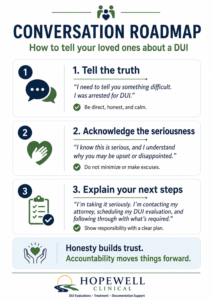
“I need to tell you something difficult. I was arrested for DUI. I know this is serious, and I understand you may be upset or disappointed. I’m still learning exactly what the legal and evaluation process will involve, but I’m taking it seriously. I’m going to speak with my attorney, schedule the required DUI evaluation, and follow whatever recommendations are made.”
That type of statement does several important things at once. It tells the truth. It does not shift blame. It acknowledges the emotional impact on the other person. It also gives your loved one something concrete to hold onto: you are taking action.
If you already know more details, you can add them carefully. For example:
“I have a court date coming up, and I may need to complete a DUI evaluation and DUI Risk Education or treatment depending on the evaluation results. I’m trying to handle this the right way instead of avoiding it.”
That last sentence matters. Loved ones may be angry, but they are often more reassured by action than by apology alone.
What Your Loved Ones May Need to Hear
When someone hears that you got a DUI, they may have several concerns at once. Some are emotional. Some are practical. Some are safety-related.
They may want to know:
| Their concern | What they may really be asking |
|---|---|
| “Were you hurt?” | Are you physically okay? Was anyone else harmed? |
| “How did this happen?” | Was this a one-time lapse, a pattern, or something you have not told me? |
| “Are you going to lose your license?” | Will this affect work, parenting, finances, or transportation? |
| “Do you have a drinking problem?” | Is there a larger substance use concern that needs help? |
| “What are you doing about it?” | Are you accepting responsibility or minimizing it? |
You do not have to have every answer immediately. It is acceptable to say, “I do not know yet, but I am finding out.” What you should avoid is pretending the situation is minor when it may have legal, financial, family, employment, or licensing consequences.
Do Not Lead With Excuses
It is natural to want to explain. Maybe you barely felt impaired. Maybe you were pulled over close to home. Maybe you believe the stop was questionable. Maybe you were dealing with grief, stress, divorce, work pressure, or family conflict. Those details may matter later, especially when speaking with your attorney or evaluator.
But when telling loved ones, too much explanation can sound like avoidance.
Try not to start with:
- “It wasn’t that bad.”
- “The officer was just looking for a reason.”
- “Everyone drives after a few drinks.”
- “I was fine.”
- “This is being blown out of proportion.”
- “You don’t understand what I’ve been dealing with.”
Some of those statements may reflect real frustration, but they usually do not help rebuild trust. A better approach is:
“There are details I still need to sort out with my attorney, but I know the situation is serious. I should not dismiss it, and I am not asking you to pretend it does not matter.”
This keeps you from making legal admissions beyond what is necessary, while still showing maturity.
Be Clear About What You Are Doing Next
Loved ones often calm down when they see a plan. The plan does not need to be dramatic. It needs to be credible.
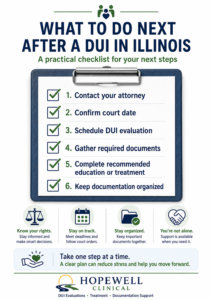
A practical next-step plan may include:
- Contacting or following up with your attorney.
- Reviewing your court date and bond conditions.
- Scheduling an Illinois DUI evaluation with a licensed provider.
- Gathering documents such as your Law Enforcement Sworn Report, chemical test or refusal information, court paperwork, and driving abstract if available.
- Completing DUI Risk Education, early intervention, treatment, or continuing care if recommended.
- Avoiding alcohol or drug use if that is appropriate for your situation or recommended by your attorney, evaluator, court, probation, or treatment provider.
- Making a transportation plan if your license status is affected.
In Illinois, the Alcohol/Drug Evaluation Uniform Report is the IDHS/DBHR-mandated report produced through eDSRS and used to summarize the DUI evaluation for the circuit court or the Illinois Office of the Secretary of State. The Secretary of State also states that an Alcohol/Drug Evaluation Uniform Report must be completed after the most recent DUI arrest by a DBHR-licensed agency and that the evaluation places the person at a classification level with additional requirements depending on that classification.
What to Say If They Ask, “Do You Have a Drinking Problem?”
This is one of the hardest questions because it can feel accusatory. Try not to answer defensively. Also, avoid diagnosing yourself too quickly in either direction.
A balanced response might be:
“I do not want to minimize what happened. I also do not want to make assumptions before I complete the evaluation. I’m willing to look honestly at my alcohol or drug use, answer the questions truthfully, and follow the recommendations.”
That answer is stronger than saying, “No, absolutely not,” especially if your loved one has seen concerning patterns before. It is also more accurate than saying, “Yes, I’m an alcoholic,” if that has not been clinically assessed.
Alcohol Use Disorder is a medical condition involving impaired ability to stop or control alcohol use despite negative consequences, and it can range from mild to severe. A DUI arrest does not automatically mean someone has Alcohol Use Disorder, but it can be a significant warning sign that deserves honest assessment.
How Much Detail Should You Share?
Share enough to be honest, but not so much that the conversation turns chaotic.
A useful rule is: facts first, interpretation second, future plan third.
Facts
“I was arrested for DUI on Saturday night.”
Interpretation
“I know this is serious, and I understand why you may be upset.”
Future plan
“I am contacting my attorney, scheduling the evaluation, and making sure I understand what the court or Secretary of State may require.”
Avoid giving a minute-by-minute account unless the person truly needs it. For example, a spouse may need more practical information than a parent who lives out of state. An employer may only need to know if your schedule, driving status, or job duties are affected. A child may need a much more age-appropriate explanation.
If You Are Telling Your Spouse or Partner
A spouse or partner may experience the DUI as a trust issue, not only a legal issue. They may wonder whether you hid your drinking, drove unsafely with the family vehicle, risked employment, or put the household under financial pressure.
Try to address the practical and emotional concerns directly:
“I know this affects more than just me. It may affect our finances, transportation, schedule, and trust. I am not asking you to act like it is okay. I am asking for the chance to handle it responsibly and keep you informed.”
You may also need to discuss immediate logistics:
- Who will drive if your license is suspended or revoked?
- Are there court dates or evaluation appointments that affect childcare?
- Are there attorney fees, evaluation fees, DUI Risk Education fees, or treatment costs?
- Does your partner need to attend any appointment, provide collateral information, or help gather records?
- Would couples counseling or family counseling be useful?
SAMHSA notes that family members may help connect loved ones with treatment, resources, and services, while also needing to protect their own health and support.
If You Are Telling Your Parents
Parents may respond with fear, disappointment, criticism, or immediate problem-solving. Even adult children can feel reduced to a teenager again in this conversation.
Try to stay grounded:
“I know this is upsetting to hear. I’m not proud of it, and I’m not trying to excuse it. I wanted you to hear it from me instead of finding out another way. I’m taking the legal and evaluation process seriously.”
If your parents tend to overreact, set boundaries respectfully:
“I’m willing to talk about it, but I need the conversation to stay constructive. I understand you may be angry. I’m already taking steps to address it.”
If your parents are financially involved, be especially careful not to ask for help before showing responsibility. A better approach is to explain the steps and then, if needed, discuss whether assistance is possible.
If You Are Telling Your Children
This depends heavily on the child’s age, maturity, and whether the DUI affects their daily life. A young child does not need legal details. An older child or teenager may need more honesty, especially if transportation, family stress, or court obligations affect them.
For a younger child:
“I made a mistake and have some grown-up responsibilities to take care of. You are safe, and this is not your fault.”
For an older child or teenager:
“I was arrested for driving after drinking, and I should not have put myself in that situation. I am taking responsibility, going through the court process, and getting an evaluation. I understand if you are upset or have questions.”
Do not use your child as your emotional support system. It is appropriate to be honest. It is not appropriate to make them responsible for comforting you.
If You Are Telling an Employer
This is more complicated. Whether you need to disclose a DUI to an employer may depend on your job duties, employment contract, professional license, company policy, whether you drive for work, and whether the case affects your schedule or legal eligibility to perform your job. This is an area where you should consult your attorney before saying more than necessary.
If disclosure is required or practically necessary, keep it brief and professional:
“I need to inform you that I have a pending DUI matter. I am addressing it through the appropriate legal and evaluation process. I will keep you informed if there is any impact on my schedule or job duties.”
Avoid oversharing personal details at work. Also avoid making promises you cannot guarantee, such as “This will not affect anything,” unless you are certain.
What If Your Loved One Gets Angry?
They may. That does not mean the conversation failed.
A DUI can scare people. It may bring up past experiences with addiction, family conflict, loss, or unsafe driving. Anger is often mixed with fear.
You can respond with:
“I understand why you are angry. I’m not asking you to excuse it. I just wanted to be honest and let you know what I’m doing next.”
If the conversation becomes verbally abusive or unproductive, pause it:
“I want to keep talking, but I do not think either of us is going to handle this well if we continue right now. Can we come back to it later today?”
Taking a break is not avoidance if you return to the conversation.
What If You Feel Ashamed?
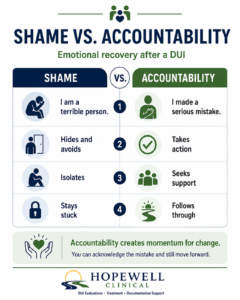
Shame is common after a DUI, but shame alone does not produce change. In fact, shame can make people hide, isolate, avoid appointments, drink more, or delay handling court and Secretary of State requirements.
A more useful response is accountability.
Shame says: “I am a terrible person.”
Accountability says: “I made a serious mistake, and I need to respond differently now.”
That difference matters. Loved ones usually do not need you to hate yourself. They need to see that you understand the seriousness of what happened and are willing to follow through with the necessary steps.
How a DUI Evaluation Can Help the Conversation
A DUI evaluation is not only paperwork. It can help clarify what level of intervention may be required and whether the situation appears isolated, risky, or part of a broader pattern.
Under Illinois Administrative Code, the DUI evaluation includes a comprehensive alcohol and drug use history, alcohol- and drug-related legal and driving history, prior evaluation or treatment history, family history of substance use disorders, criminal history, and related records such as the Law Enforcement Sworn Report and driving abstract information.
That matters when speaking with loved ones because it moves the conversation from vague fear to concrete next steps.
Instead of saying:
“I don’t know what’s going to happen.”
You may eventually be able to say:
“I completed the evaluation. My risk classification and recommendations are now clearer. I know what I need to complete, and I’m following through.”
That kind of follow-through is often what begins rebuilding trust.
Illinois DUI Requirements Your Loved Ones May Ask About
A DUI can affect court, probation, driving privileges, employment, family schedules, and Secretary of State requirements. You do not need to become a legal expert, but you should understand the general categories.
| Issue | Why it matters |
|---|---|
| DUI evaluation | Helps determine risk classification and recommended intervention |
| DUI Risk Education | Often required as part of DUI-related requirements; Secretary of State states the course requirement cannot be waived for its hearing requirements |
| Early intervention | May be recommended for Moderate Risk cases |
| Treatment | May be recommended for Significant Risk or High Risk cases, or when clinically indicated |
| Continuing care documentation | May be needed after treatment, especially for Secretary of State hearings |
| License reinstatement | May require hearing, evaluation, proof of treatment, remedial education, proof of financial responsibility, fees, and testing depending on the case |
| BAIID / Restricted Driving Permit | May become relevant for some drivers seeking limited driving relief |
For revocation cases, the Illinois Secretary of State explains that a person seeking reinstatement after a DUI conviction must appear before a hearing officer, undergo an alcohol/drug evaluation, complete required education or treatment, file proof of financial responsibility, pay required fees, and complete license testing.
Get Clear Before the Conversation Gets Bigger
If you recently received a DUI in Illinois and need to understand your evaluation, DUI Risk Education, treatment, or Secretary of State documentation requirements, call Hopewell Clinical at 217-223-0170. Hopewell Clinical can help you understand what documents to bring, how the DUI evaluation process works, and what may come next for court, probation, attorney review, or license reinstatement documentation.

Common Mistakes to Avoid When Telling Loved Ones
Mistake 1: Waiting until they find out from someone else
If the DUI is likely to affect your family, schedule, finances, or transportation, it is usually better to tell key loved ones directly. Finding out indirectly can create a second injury: not only did the DUI happen, but they may feel deceived.
Mistake 2: Telling too many people too soon
You do not owe everyone your story. Start with the people who are directly affected or who are part of your support system. Be careful with social media, casual acquaintances, and workplace conversations.
Mistake 3: Making promises before you understand the process
Avoid saying, “This will all be over soon,” or “I won’t have to do treatment,” before your evaluation, court process, or attorney review is complete. Illinois DUI recommendations depend on the evaluation, risk classification, legal history, BAC or refusal information, substance use history, and other case-specific factors.
Mistake 4: Treating the evaluation as a formality
The evaluation is not just a box to check. The Uniform Report summarizes the assigned risk level and corresponding intervention, and Illinois rules require all sections to be complete and signed.
Mistake 5: Asking for forgiveness without changing behavior
An apology matters, but follow-through matters more. Attend appointments, complete recommendations, avoid missed deadlines, keep documentation organized, and communicate honestly.
A Practical Script You Can Adapt
Here is a fuller version you can use and personalize:
“I need to tell you something serious. I was arrested for DUI. I know this is disappointing and upsetting, and I’m not proud of it. I’m still working through the legal details, so I may not have every answer today. What I can tell you is that I’m taking it seriously. I’m going to talk with my attorney, complete the DUI evaluation, gather the required documents, and follow the recommendations. I understand this may affect trust, transportation, money, and our family schedule. I’m sorry for putting us in this position, and I want my actions from here forward to show that I understand the seriousness of it.”
This script works because it does not over-explain, over-promise, or collapse into self-pity. It is accountable without being theatrical.
A Checklist Before You Tell Them
Before the conversation, write down a few facts so you do not ramble or become defensive.
Before the conversation:
- Confirm your next court date.
- Contact or plan to contact your attorney.
- Write down whether your license is suspended, revoked, or still valid.
- Gather any paperwork from the arrest.
- Schedule or prepare to schedule your DUI evaluation.
- Decide what you are asking from the loved one, if anything.
- Prepare to listen without interrupting.
- Decide what details are private and what details need to be shared.
During the conversation:
- Be direct.
- Avoid blaming others.
- Acknowledge the seriousness.
- Explain next steps.
- Let them react.
- Do not demand immediate forgiveness.
- End with a specific plan.
Local DUI Evaluation and Treatment Support in Illinois
Hopewell Clinical works with clients who are trying to navigate the DUI evaluation process, DUI Risk Education and treatment recommendations, continuing care documentation, and Secretary of State hearing-related documentation. Clients often come from Quincy, Adams County, Springfield, Sangamon County, Jacksonville, Morgan County, and other Illinois communities where transportation, work schedules, family responsibilities, and court deadlines can make the process more stressful.
For some clients, telehealth may reduce barriers such as travel time, childcare needs, work conflicts, or limited access to local providers. Whether telehealth is appropriate depends on the service, client needs, documentation requirements, and applicable Illinois rules or referral expectations.
If your loved ones are asking, “What are you doing now?” one credible answer is: “I’m scheduling the evaluation and getting the documentation handled correctly.”

A DUI can be frightening, but avoidance usually makes it worse. If you need a DUI evaluation before court, probation, attorney review, or a Secretary of State hearing, call Hopewell Clinical at 217-223-0170 to ask about scheduling, required documents, Illinois telehealth options, DUI treatment support, and documentation for license reinstatement or continuing care.
Hopewell Clinical provides clinical evaluation, treatment, and documentation support. Legal strategy should be discussed with your attorney.
FAQ
Should I tell my family that I got a DUI?
If the DUI may affect your household, finances, transportation, work schedule, parenting, or emotional well-being, it is usually better to tell close family members directly. You do not have to share every legal detail, but you should be honest about what happened, what you know so far, and what steps you are taking next.
What should I say when I tell someone I got a DUI?
A simple statement is best: “I was arrested for DUI, I know it is serious, and I am taking steps to address it.” Then explain that you are contacting your attorney, scheduling the DUI evaluation, gathering required paperwork, and following any court, probation, or Secretary of State requirements.
Does getting a DUI mean I have a drinking problem?
Not automatically. A DUI does not by itself diagnose Alcohol Use Disorder, but it is serious enough to warrant honest assessment. In Illinois, the DUI evaluation reviews alcohol and drug use history, driving history, legal history, and other relevant information to determine a risk classification and recommended intervention.
Can Hopewell Clinical help me after a DUI in Illinois?
Yes. Hopewell Clinical provides DUI evaluations, substance use assessments, DUI treatment support, continuing care documentation, and Secretary of State DUI hearing documentation help. Services are available in Quincy, Springfield, Jacksonville, surrounding Illinois communities, and through appropriate telehealth options. Call 217-223-0170 to ask about scheduling and what documents to bring.
Reviewed by Matt Dutton, BA, CADC