
Written by Hopewell Clinical
Reviewed by Matt Dutton, BA, CADC
Quick Summary:
If you were denied after an Illinois Secretary of State Administrative Hearing for DUI, the next step is to review the denial order carefully, correct the documentation or testimony issues, and prepare for the next eligible informal or formal hearing. Depending on your case, you may need an updated Alcohol/Drug Evaluation Report Update, treatment verification, a Continuing Care Status Report, support or abstinence letters, BAIID documentation, or additional clinical clarification. Hopewell Clinical helps clients in Quincy, Springfield, Jacksonville, and across Illinois prepare clinical documentation for Secretary of State DUI hearings. Call 217-223-0170 to ask about scheduling and required documents.

A denial after an Illinois Secretary of State hearing can feel discouraging, especially if you believed you had completed everything required. But a denial does not always mean you are starting over. Often, it means the Secretary of State needs clearer proof, updated records, more consistent testimony, or better documentation showing that the issues connected to the DUI have been addressed.
This article explains how to prepare after a DUI hearing denial in Illinois, what documents commonly need to be reviewed, and how Hopewell Clinical can help with the clinical evaluation, treatment, continuing care, and documentation side of the process. It is not legal advice. For hearing strategy, appeal rights, or case-specific legal recommendations, speak with your attorney.
First, Understand What Kind of Hearing Was Denied
Illinois has two main types of Secretary of State hearings: informal and formal. A formal hearing is required for people whose driving privileges were suspended or revoked because of an offense involving a fatality or multiple DUI dispositions, while an informal hearing generally applies to a single DUI arrest or certain other sanctions not involving a fatality.
The type of denial matters because it affects what you can do next. According to the Illinois Secretary of State’s Road to Reinstatement, if you are denied after an informal hearing, you may apply for a formal hearing or wait 30 days from the date of the hearing for another informal hearing. If you are denied after a formal hearing, you must wait 90 days from the date of the hearing to have another hearing.
That waiting period should not be wasted. It is usually the time to gather the denial order, review your evaluation and treatment documents, correct inconsistencies, update expired records, and prepare a clearer file for the next hearing.
What a Secretary of State DUI Denial Usually Means
A denial does not necessarily mean that the hearing officer believed you were dishonest or that reinstatement will never be possible. In many cases, the denial points to specific concerns that need to be addressed before the next hearing.
Common denial-related concerns may include:
| Issue | Why It Matters | What May Help |
|---|---|---|
| Outdated evaluation | Secretary of State hearings often require updated clinical information if the Uniform Report is older than six months | Alcohol/Drug Evaluation Report Update, when appropriate |
| Incomplete treatment documentation | The Secretary of State may need proof of completed recommended treatment | Treatment verification, discharge summary, individualized treatment plan, continuing care plan |
| Weak continuing care documentation | The hearing file may not clearly show current recovery stability or follow-through | Continuing Care Status Report |
| Support letters are vague or outdated | Letters may not verify abstinence, support involvement, or use pattern clearly enough | Revised letters signed and dated within the required timeframe |
| Testimony conflicts with documents | Inconsistent dates, use history, or support system details can create credibility concerns | Careful review with attorney and provider before the next hearing |
| BAIID concerns | Violations or monitoring issues may need explanation or documentation | BAIID-related records and clinical clarification when relevant |
| Dependency/non-dependency issues | High Risk classifications may require specific documentation regarding abstinence, support, or why dependency was ruled out | Provider report, recovery/support documentation, treatment records |
The denial order is the roadmap. Read it slowly. Highlight each reason for denial and separate the issues into three categories: legal/hearing strategy, clinical documentation, and personal preparation.

Start with the denial order
Step 1: Get and Review the Denial Order
Before scheduling new services, gather the actual denial order or decision letter from the Illinois Secretary of State. This document usually identifies the concerns that prevented reinstatement or a Restricted Driving Permit.
Look for language related to: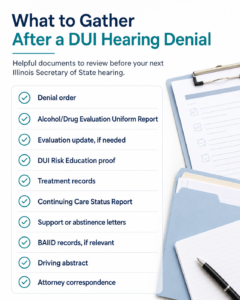
- Alcohol or drug use history
- Abstinence or non-problematic use
- Treatment completion
- Continuing care participation
- Support system involvement
- Inconsistencies in testimony
- Incomplete or outdated documents
- Need for updated evaluation
- BAIID violations or permit concerns
- Prior denial concerns that were not fully addressed
Do not rely only on memory of what happened at the hearing. People are often anxious during hearings, and it is easy to misinterpret the reason for denial. The written order should guide the next steps.
Step 2: Know Whether You Need an Updated Evaluation
For alcohol- and drug-related hearings, the Illinois Secretary of State requires an Alcohol/Drug Evaluation Uniform Report completed after the most recent DUI arrest by an agency licensed by the Division of Substance Use Prevention and Recovery. The evaluation must include a complete alcohol and drug use history and places the person at a classification level.
For Secretary of State hearings, timing matters. The Secretary of State states that if the last Uniform Report is more than six months old at the time of the hearing, an updated evaluation must be submitted. This appears across multiple risk classification requirements, including Minimal, Moderate, Significant, and High Risk categories.
However, an update is not always allowed. The Secretary of State’s Alcohol/Drug Evaluation Report Update instructions state that an update cannot be used if the petitioner has been arrested for DUI since the Uniform Report or Investigative Report was completed; in that situation, a new Uniform Report must be submitted. The same form also notes that if an agency only completed a Treatment Needs Assessment, early intervention, or continuing care, that agency may not complete the update unless the case file has transferred appropriately.
Practical point
Many denials become harder to fix when the evaluation, treatment records, and testimony do not line up. Before the next hearing, your provider should review the prior Uniform Report, use history, treatment history, discharge summary, continuing care plan, support system, and the denial order if available.
Step 3: Identify Your DUI Risk Classification and Required Documents
Illinois DUI evaluations classify individuals as Minimal Risk, Moderate Risk, Significant Risk, or High Risk. The Illinois Department of Human Services explains that the evaluator determines the classification and recommendation, which are recorded on the Alcohol/Drug Uniform Report for the court or Secretary of State.
Your classification affects the documentation needed for a Secretary of State hearing.
Minimal Risk
A Minimal Risk case generally requires the Alcohol/Drug Evaluation Uniform Report and proof of DUI Risk Education completion. If the Uniform Report is older than six months at the hearing, an updated evaluation is generally required.
Moderate Risk
Moderate Risk generally requires the Uniform Report, DUI Risk Education, and proof of Early Intervention completion. The Secretary of State specifies that proof of Early Intervention should include the number of hours completed, dates of involvement, a summary of what was explored and addressed, and the outcome.
Significant Risk
Significant Risk generally requires the Uniform Report, DUI Risk Education, and proof of successful completion of recommended substance abuse treatment. The Secretary of State lists treatment-related documentation that may include the individualized treatment plan, discharge summary, aftercare or continuing care plan, and original Continuing Care Status Report.
High Risk — Dependent
High Risk Dependent cases generally require treatment documentation, continuing care documentation, establishment of a support or recovery program, and letters verifying abstinence. The Secretary of State states that people seeking reinstatement need abstinence verification for at least 12 months, while those seeking a driving permit need no less than six months; letters must be signed and dated within 45 days before the hearing.
High Risk — Non-Dependent
High Risk Non-Dependent cases also require treatment documentation when treatment was recommended. The Secretary of State further requires letters verifying the current alcohol/drug use pattern or abstinence and an additional treatment provider report explaining why dependency was ruled out and the cause of the behavior that resulted in three or more DUI dispositions. This requirement cannot be waived.
Step 4: Build a Hearing File, Not Just a Stack of Papers
A strong Secretary of State file should tell one coherent story. The documents should support the same timeline, the same use history, the same recovery or behavior-change narrative, and the same current functioning.
Use this checklist as a practical starting point:
| Document | Why It May Be Needed |
|---|---|
| Denial order or decision letter | Identifies what must be corrected before the next hearing |
| Alcohol/Drug Evaluation Uniform Report | Establishes risk classification and recommendations |
| Alcohol/Drug Evaluation Report Update | Updates current use pattern, treatment completion, and new concerns when required |
| DUI Risk Education completion proof | Required for alcohol/drug-related hearings |
| Early Intervention proof | Needed for Moderate Risk when recommended |
| Individualized Treatment Plan | Shows what treatment addressed |
| Discharge Summary | Shows completion, progress, diagnosis, prognosis, and discharge status |
| Continuing Care Plan | Shows post-treatment recommendations |
| Continuing Care Status Report | Shows current follow-through and stability |
| Support/recovery letters | Verifies support system involvement, abstinence, or current use pattern |
| BAIID records, if relevant | Helps address permit or interlock-related concerns |
| Driving abstract or Court Purposes Driving Abstract | Helps clarify the official driving history |
| Attorney correspondence | Helps align legal strategy with documentation |

Denied does not always mean starting over. It means preparing more clearly.
Do not assume that “more paperwork” automatically means a stronger case. A clean, consistent, relevant file is usually better than a large file full of outdated, duplicative, or contradictory documents.
Step 5: Correct Common Documentation Problems Before the Next Hearing
After a denial, the most important question is not simply, “What form do I need?” The better question is, “What concern did the hearing officer identify, and what documentation directly answers that concern?”
Problem: The evaluation is too old
If the Uniform Report is more than six months old at the hearing, an update is commonly required. Do not schedule a hearing first and then scramble for an update the week before.
Problem: Treatment records do not show what was actually addressed
A treatment completion letter that only says “completed treatment” may not be enough in some cases. Significant Risk and High Risk cases often need more detailed documentation, including the treatment plan, discharge summary, continuing care plan, and Continuing Care Status Report.
Problem: Continuing care is vague
If the continuing care plan says the client should maintain abstinence, attend support meetings, avoid high-risk situations, or continue counseling, the Continuing Care Status Report should explain whether the client is actually doing those things.
Problem: Support letters are too general
A letter that says “he is doing well” may be supportive, but it may not answer the Secretary of State’s question. Letters should usually identify the writer’s relationship to the petitioner, how often they see or speak with the person, what they know about the person’s alcohol or drug use pattern or abstinence, and the timeframe they can verify.
Problem: Dates conflict
One document may say treatment ended in March, another says April, and testimony may say February. These may seem like small differences, but inconsistency can matter in a hearing. Before the next hearing, review dates carefully.
Problem: Dependency concerns are not addressed
For High Risk Non-Dependent cases, the Secretary of State requires a report explaining why dependency was ruled out and the cause of the behavior resulting in three or more DUI dispositions. This requirement cannot be waived.
If you were denied after an Illinois Secretary of State DUI hearing and need help reviewing your clinical documentation, call Hopewell Clinical at 217-223-0170. We can help determine whether you may need an updated evaluation, treatment verification, continuing care documentation, or Secretary of State hearing support records.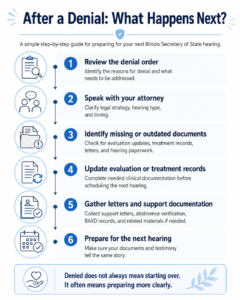
Step 6: Prepare Your Testimony With Your Attorney
Hopewell Clinical can help with clinical documentation, evaluation updates, treatment records, continuing care reports, and substance use-related recommendations. We do not replace your attorney.
Before your next hearing, ask your attorney how to prepare for questions about:
- Your complete alcohol and drug use history
- Your last use date or current use pattern
- What changed after the DUI
- Why prior treatment was successful or unsuccessful
- How you manage relapse risk or high-risk situations
- Your support system
- Your work, family, transportation, and hardship needs
- BAIID history, if relevant
- Why you are now a safe and responsible candidate for driving relief
The most common problem is not that the person has no answer. It is that the answer is vague, inconsistent, or different from the written records. The testimony and documentation should support each other.
Step 7: Understand RDP vs. Full Reinstatement
A Restricted Driving Permit is different from full reinstatement. The Illinois Secretary of State explains that an RDP allows driving on a restricted basis at designated times and in specified areas for certain purposes when no other transportation is available, such as employment, recovery meetings, medical needs, daycare, or education.
For some individuals, especially those with multiple DUI convictions, the path may involve an RDP and BAIID before full reinstatement. The Secretary of State states that if a person has two or more alcohol/drug-related driving incidents, a formal hearing is required to be granted an RDP, and once the RDP is issued, the person has 14 days to install a BAIID on vehicles they want to drive during the permit period.
This is one reason the hearing preparation process should be specific. Preparing for an RDP hearing may require hardship proof and permit-related planning, while preparing for full reinstatement may require stronger proof of long-term stability, abstinence or non-problematic use, and compliance with prior requirements.
Court Requirements vs. Secretary of State Requirements
Many Illinois DUI clients assume that completing court requirements automatically resolves license reinstatement. That is not always the case.
The court process and Secretary of State process are related, but they are not the same. The court may impose sentencing, supervision, fines, DUI Risk Education, treatment, or other conditions. The Secretary of State separately determines whether a person qualifies for driving relief after suspension or revocation.
The Illinois Department of Human Services notes that if the evaluation is for the Secretary of State in relation to return of full or limited driving privileges, the defendant is required to complete any recommendations contained in the alcohol and drug evaluation.
That difference matters after a denial. A client may have “finished court” but still need updated treatment documentation, continuing care reports, support letters, abstinence verification, BAIID documentation, or an updated evaluation for the Secretary of State.
Telehealth Considerations After a Denial
Telehealth can be helpful for clients who live far from a provider, work difficult hours, lack transportation, or are preparing for a Secretary of State hearing from another Illinois community. However, telehealth does not reduce the need for complete documentation.
For DUI-related services, the key question is not simply whether the appointment can be completed online. The key question is whether the provider can properly review the required documents, complete the correct forms, verify treatment history, and prepare records that are appropriate for the hearing.
Hopewell Clinical provides appropriate Illinois telehealth options when clinically and administratively suitable. Clients should ask in advance what documents are needed, whether a new Uniform Report or update is appropriate, and whether prior records must be transferred before the appointment.
Local Help for DUI Hearing Documentation in Quincy, Springfield, Jacksonville, and Illinois Telehealth Areas
Hopewell Clinical works with clients preparing for Illinois DUI evaluations, Secretary of State hearing documentation, DUI treatment records, continuing care documentation, and license reinstatement-related clinical paperwork.
We commonly assist clients from:
- Quincy and Adams County
- Springfield and Sangamon County
- Jacksonville and Morgan County
- Peoria and Peoria County
- Galesburg and Knox County
- Decatur and Macon County
- Bloomington-Normal and McClean County
- Macomb and McDonough County
- Many other communities across Illinois using telehealth service areas
The goal is to reduce confusion and delay. Many people contact us after realizing that the Secretary of State hearing process requires more than simply bringing an old evaluation or a treatment completion letter.
Practical Timeline After a DUI Hearing Denial
| Timeframe | Recommended Action |
|---|---|
| Immediately after denial | Save the denial order. Contact your counselor and attorney (if applicable) |
| First 1–2 weeks | Identify whether the denial involved legal issues, testimony issues, or documentation issues |
| Before scheduling next hearing | Confirm whether you need an updated evaluation or additional treatment/continuing care documentation |
| 30–60 days before hearing | Gather support letters, BAIID records, and hardship documentation |
| Within 45 days before hearing | Make sure required letters are signed and dated within the Secretary of State timeframe |
| Final 1–2 weeks | Review consistency between testimony, evaluation, treatment records, and support letters |
The exact timeline depends on your case, hearing type, attorney availability, provider scheduling, and whether records must be obtained from prior agencies.
Common Mistakes That Can Delay the Next Hearing
Waiting too long to request prior records
Treatment agencies, evaluators, and attorneys may need time to locate records. If your case involves treatment from years ago, start early.
Assuming the same paperwork can be reused
Some documents expire or become stale. A Uniform Report older than six months at the hearing generally requires an update.
Getting letters that do not verify the right issue
Support letters should be specific. For High Risk cases, letters may need to verify abstinence, support program involvement, or current alcohol/drug use pattern depending on the classification and relief requested.
Not addressing the exact denial reason
If the denial order raised concerns about inconsistent testimony, simply getting a new completion letter may not fix the problem. If the denial focused on lack of continuing care, a new evaluation alone may not be enough.
Scheduling before documents are ready
An early hearing date may feel productive, but it can backfire if the file is incomplete. Work backward from the hearing date and confirm each required document.

How Hopewell Clinical Can Help
Hopewell Clinical can help with the clinical and documentation parts of the DUI hearing preparation process, including:
- Illinois DUI evaluations
- Alcohol/Drug Evaluation Report Updates, when appropriate
- DUI treatment documentation
- Continuing Care Status Reports
- Treatment verification records
- Aftercare and continuing care planning
- Secretary of State hearing documentation support
- BAIID-related clinical documentation support when relevant
- Coordination with attorneys, probation, or referral sources when releases are signed
Hopewell Clinical does not guarantee reinstatement, does not guarantee a Restricted Driving Permit, and does not provide legal advice. The purpose of clinical documentation is to accurately reflect the client’s evaluation, treatment history, progress, current functioning, and recommendations.
If your Illinois Secretary of State DUI hearing was denied, do not wait until the next hearing is already scheduled to review your paperwork. Call Hopewell Clinical at 217-223-0170 to ask about DUI evaluation updates, treatment verification, continuing care documentation, and Secretary of State hearing preparation support.
FAQ
What should I do first after being denied at an Illinois Secretary of State DUI hearing?
The first step is to review the denial order carefully with your attorney. The denial order usually identifies the issues that need to be corrected before the next hearing, such as incomplete documents, inconsistent testimony, outdated evaluations, or missing treatment records.
How long do I have to wait after a Secretary of State DUI hearing denial in Illinois?
If you are denied after an informal hearing, you may apply for a formal hearing or wait 30 days from the date of the hearing for another informal hearing. If you are denied after a formal hearing, you must wait 90 days from the date of the hearing to have another hearing.
Do I need a new DUI evaluation after a denial?
You may need an updated evaluation if your Alcohol/Drug Evaluation Uniform Report will be more than six months old at the time of the next hearing. If you have had a new DUI arrest since the prior Uniform Report, an update cannot be used and a new Uniform Report must be submitted.
Can Hopewell Clinical help me get my license reinstated?
Hopewell Clinical can help with the clinical side of the process, including DUI evaluations, updated evaluations, treatment documentation, continuing care reports, and Secretary of State hearing documentation support. We cannot guarantee reinstatement or replace legal counsel, but we can help ensure the clinical records are complete, accurate, and organized.